



Hi friends,
This week - good news for UK-based prostate cancer screening, European healthtech funding and super fast drug development, but less so for the AI dystopian avoidants among us… (& happy Halloween, Pigeon fans!)
🎙️ Fancy this in podcast form? James and Jessica from SomX chat through the one-stop prostate cancer diagnostics service and the next thing in town for big tech and wearables - AI assistants that don’t bombard you with signals but give you contextual info as and when you need it.
And it’s on YouTube. Did you know adult users spend an average of 46 minutes per day on YouTube? Now you do. Guess how long this video is? 42 mins. So get your quota and 4 mins spare to watch whatever the heck you want.

Do you have a project that tackles an urgent priority in women’s health? Ripple Women’s Digital Health Challenge 2025 invites innovators worldwide to join a proven 12-month programme to turn ideas into pilot-ready, patient-facing apps on the Cogniss no-code platform, with expert support. Delivered by Cogniss, the Health Innovation Network (HIN), AWS and SomX, the programme offers clear pathways to piloting and adoption. Applications close on Wed 5 Nov 2025 at 11:59 pm Pacific Time, with judging on Thurs 4 Dec 2025.
News Bites 🥪
🏥 The NHS’s “One-Day” AI cancer scan: A new 100-man pilot for an AI-powered “one-day diagnostics” service for prostate cancer was launched in Leeds this week, backed by the folks at NHS England. The tool uses AI to analyse MRI scans in minutes and has the lofty yet ambitious goal of bundling together all key investigations in a patient’s single hospital visit. And since speed seems to be the main goal here (heck, the entire patient pathway is being designed around it), rollout to 15 other sites is on the cards next. Setting a new standard for patient care and slashing the agonising wait for an answer? Gets the Pigeon stamp of approval.
💊 Lilly partners with Nvidia on AI supercomputer to speed up drug development: Pharma behemoth Eli Lilly is teaming up with AI behemoth NVIDIA to build a new supercomputer aimed at discovering drugs way, way faster than they are currently (very Terminator 2 vibes, but we’ll watch with baited breath eh). As drug development is famously slow and astronomically expensive, this pseudo-Avengers Assemble approach is making a massive bet that generative AI can be used to simulate millions of experiments and test potential new medicines digitally: Basically, like giving drug researchers a time machine (I repeat, Terminator 2 vibes, anyone?), which will also form part of an ecosystem of AI models available to other biotech companies via a new platform called SkyNet Lilly TuneLab (don’t say we didn’t warn you).
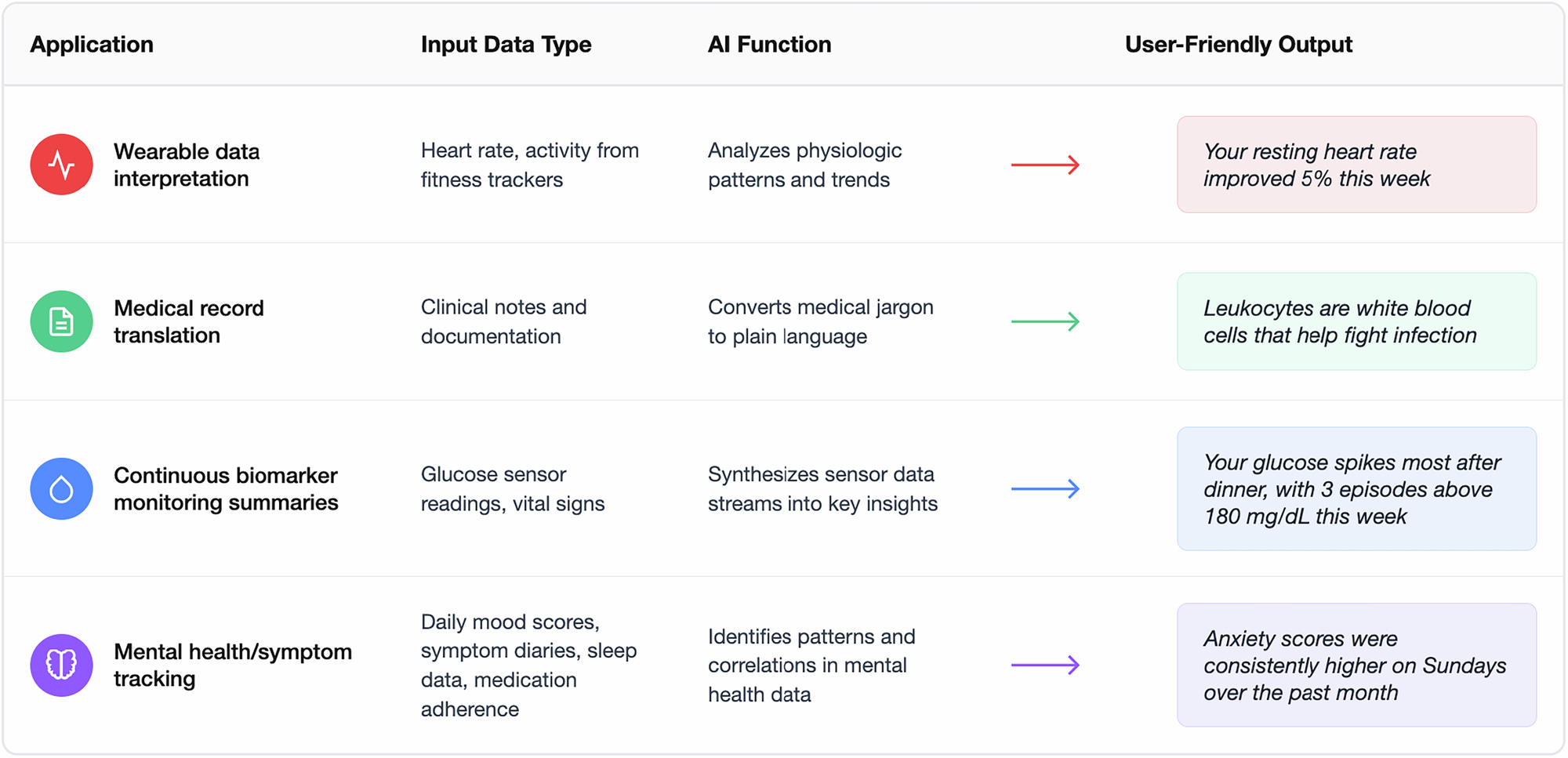
🤯 Drowning in data? AI wants to be your lifeguard: A new wave of thinking is asking in Nature Opinion this week as to whether we’ve hit “peak data”: The rise of digital health tech (CGMs, smart rings, etc.) is giving consumers so much biometric data that it’s causing decision fatigue, anxiety, and information overload among the masses, and emerging studies are showing can actually make people less healthy as they just tune out the noise. This is where AI assistants could actually be useful, so, the idea is to create an AI guardian that filters the noise: Instead of just showing you a glucose spike, for example, it might prompt you with a “Hey, that 3pm spike was probably that chunk of office birthday cake. No biggie, but maybe a quick walk?”*
✂️ Melinda French Gates-backed startup Tia cuts 23% of staff: Tia, once-promising, high-profile, Melinda French Gates-backed women’s health company, has laid off 72 employees across both corporate and clinical divisions this past week. CEO Felicity Yost said it was part of plan to “accelerate its path to profitability,” but let’s be honest, it’s a warning shot for others in the industry trying to achieve the benchmark of running a successful hybrid brick-and-mortar digital health org.
🩺 Health education giant teams with Google on a new AI credential: Health education giant Adtalem is partnering with Google Cloud to create a new AI credential to teach healthcare students and practicing professionals how to better use AI. As we all know that a doctor (not-so-secretly) using ChatGPT for notes isn’t a good long-term strategy for best practice in the clinical workforce arsenal, Pigeon feels that anyone making strides to set an industry standard on safe and effective use at scale for AI among healthcare professionals is most definitely a good thing.
🦄 Female-founded UK HealthTech startup reaches unicorn status: Swinging the other way from Tia’s bad news, female-founded health tech company SheMed has reached unicorn status after a USD$50 million (£37.3m) raise took its valuation to a very swanky $1bn. The UK-based startup’s model is a digital platform specific to women’s weight management, built around GLP-1 medications but offering wraparound care with medical advice as well as community support. SheMed claim the funding will be used to expand their UK operations, scaling medical and technology teams, and is a huge nod to the billion-dollar opportunities that lie in women’s-specific care within and outside of the GLP-1 gold rush.
💰 Europe’s most active healthtech VC Calm/Storm closes €30m fund: In further funding news, Vienna-based Calm/Storm Ventures are leading fresh cash injections for the European healthtech scene, having just closed a new €30 million fund to back early-stage healthtech startups. Refreshingly, their approach focuses on investing in the “overlooked” or taboo areas in healthcare, from mental health to sexual wellness, infertility, and chronic conditions, and they’re walking the walk on diversity: nearly half their 75+ portfolio companies have diverse teams, and about a third of the CEOs don’t identify as male. It’s a clear sign that VCs see massive, untapped markets in the health issues we used to whisper about (not Pigeon obviously - long been an ally for all the things 🐦).
What to Listen to 🔊
Events 📅
8th ZIMAM Digital Health Forum
📅 November 4 - 8
📍Dubai, UAE
OHT London: Monthly HealthTech Breakfast: Spotlight on Health Equity
📅 November 4
📍 Hale House, London
NXGN The Launch Equation @ Hale House (sponsored by Alethira)
📅 November 5
📍 Hale House, London
HealthtechX
📅 November 5
📍 Hurlingham Club, London
The King’s Fund Annual conference 2025
📅 Nov 5 - 6
📍 London
IEEE Global Public Health Forum 2025 – Powering AI for Climate-Ready Population Health
📅 Nov 6
📍London, UK
BMJ Future Health conference
📅 Nov 6 - 7
📍 London
💡 Save 20% off the ticket price with the code PIGEON20
MedTech World Malta 2025
📅 Nov 12 - 14
📍 Malta
Artificial Intelligence in Medicine: President’s Conference 2025
📅 Nov 114
📍 Online & at Royal College of Physicians and Surgeons of Glasgow
Medica
📅 Nov 17 - 20
📍 Dusseldorf, Germany
Opportunities 🕵️♀️

Ripple Women’s Digital Health Challenge 2025: You know how much we love women’s health at Healthtech Pigeon, so consider this your nudge to apply to Ripple Women’s Digital Health Challenge 2025, a 12-month programme that turns proposals into pilot-ready apps on the Cogniss no-code platform. If you’re an innovator building inclusive, patient-centred tools that directly reach women and communities across menstrual and gynaecological health, menopause, maternal and perinatal health, cancers, mental health, fertility, pelvic health, cardiovascular, metabolic, musculoskeletal or bone health, or equity of access, enter now!! But hurry, applications close Wed 5 Nov 2025 at 11:59 pm PT.
👨💻 Member of Technical Staff at Anterior: Anterior have the bold goal of transforming healthcare administration and are looking across the board to hire from infra to frontend to work on their AI-powered platform designed by clinicians. They’re also open to juniors passionate about coding and hacking - so why not shoot your shot?
💃 Medical Director (GP) at FUTURE WOMAN: Looking for a part-time but high-powered role? FW are on the hunt for a passionate and experienced UK based GP to join as their part-time Medical Director and lead a newly launched virtual bHRT clinic. If you’re passionate about shaping the future of women’s hormone health in the UK, this one’s for you.
📰 Clinical Editor at BMJ: Love medical writing and research? Then this is a great opportunity to join The BMJ as a Clinical Editor, and to rotate through roles which provide support across a host of the journal’s functions ad portfolio for commissioning, content development, and journal development.
💊 Expression of Interest: Medical Directors (MD) at Novartis: Open call from the Big Pharma giant for a host of MDs they’re looking to recruit across multiple therapeutic areas to guide breakthrough therapies from concept to reality. Successful candidates collaborate with world-class scientists, clinicians, and cross-functional teams to shape strategies with a global impact.
👩⚕️ Director of Clinical Delivery at Oviva: Got a knack for clinical services? Oviva are on a mission to build a healthier future for all by making care for weight-related conditions more accessible and effective, combining behavioural therapy, cutting-edge technology, and a team of passionate experts to deliver app-based healthcare programs. If you’re excited about joining their leadership team with this role as they continue to expand rapidly in the UK, Switzerland, Germany, and Poland, you know what to do ☝️
And on another note…
Squirrel™ 2.0

Building an amazing healthtech product but concerned about compliance debt? 🤔 From Acorn Compliance is Squirrel™ 2.0. It launches on 5th Nov, it’s an AI-powered compliance co-pilot that streamlines all the processes and like us, it’s named after another hilarious animal. It also covers:
✅ DTAC/DCB 0129
✅ ISO 27001
✅ SaMD (up to Class IIb)
✅ ISO 42001
✅ CQC
✅ HIPAA
✅ SOC 2
etc.
If you’re interested, industry expert Michael Bell, will be demystifying the hell out of the healthtech regulatory landscape and obvs show how Squirrel™ 2.0 actually automates and streamlines the compliance stuff 5th Nov, 2pm.
📍 Register here: https://zurl.co/LfmET
HSJ Digital Awards | Entries open - Deadline Friday 14 November

Are you a healthtechy or an NHSer that has done a thing? Well, you should win an award for that thing. The HSJ Digital Awards 2026 is out to recognise the NHS’ most ground-breaking digital projects, services, and teams.
There are 25 categories around improving patient experience, driving innovation, and boosting productivity, so if you’re not doing one of those, then, frankly what on earth are you doing otherwise.
📌 Enter here (it’s free)
🔎 View the categories and download the entry guide
* I recommend listening to the Pigeon podcast this week if you’re interested in this. We talked about how we see the day very soon where the AI layer in between wearables and the consumer becomes indispensable by being contextually aware about all your biomarkers from all your devices and gives you useful information about how to improve your health on a regular (but not continual) basis without subjecting you to the entire signals. I think it’s likely to feel strange that we were ever given (for example) the literal heart trace and that all our systems were tracked by different wearables without AI contextualising it all - that we were expected to do that ourselves. It’ll be like explaining search engines to your kids/grandkids that were born into the world of LLMs… “yea so we typed random words that we thought would work, hit enter, then clicked on a load of websites and pieced the answer together after reading a load of pages…” You did what?
The Lilly NVIDIA supercomputer is a massve capital deployment signal that pharma is done waiting 15 years for clinical trial readouts when you can simulate millions of molecular interactions in silico first. The irony is that they named it TuneLab when they could have leaned into the SkyNet joke harder, but I suppose regulatory optics matter when you're trying to convince the FDA that your AI designed molecules are safe for humans. The Peak Data problem you highlighted with wearables bombarding consumers is exactly why healthtech needs an orchestration layer that prioritizes signal versus noise rather than just collecting more biometric streams. That NHS one day prostate cancer diagnostic service in Leeds shows how AI acceleration can collapse patient pathways without requiring massive behavior change from clinicians, which is usually the sticking point in adoption.