



Hello healthtech fans.
What a week: The Palantir-NHS relationship has officially reached the "maybe we should see other people" stage, Wes Streeting said the words "the NHS gaslights women" out loud (Pigeon had to read that twice), and Cera has opened a lab to, and I quote, automate everything but the human. Feels like 2026 is finding its voice…
🎙 Fancy this newsletter in podcast form? 👇 Well… This week, James and Belle from SomX put the healthtech world to rights.
Click this linky link to get the pod on Spotify. And it’s on the SomX YouTube channel if you like to look at the faces of people when they talk.

Good news (literally). Pigeon Insider has launched.
Free Pigeon stays free. Insider is where I put the stuff I can’t publish to 8000 people - the off-the-record conversations, the bets I’d actually make, the things I hear outside recordings.
If you’re building, investing, or operating in healthtech, this is the edge.
🔒 This week in Pigeon Insider: The ceiling the preventive health space is going to hit and why it’s not the ceiling anyone’s talking about. Not the price point. Not the NHS adoption timeline. Not the regulatory pathway. Something more structural than any of those. There’s a 40 year old public health concept called the “"inverse prevention law” that I’d never heard of, and that you should definitely know about if you want to convince an investor.
James
News Bites 🥪

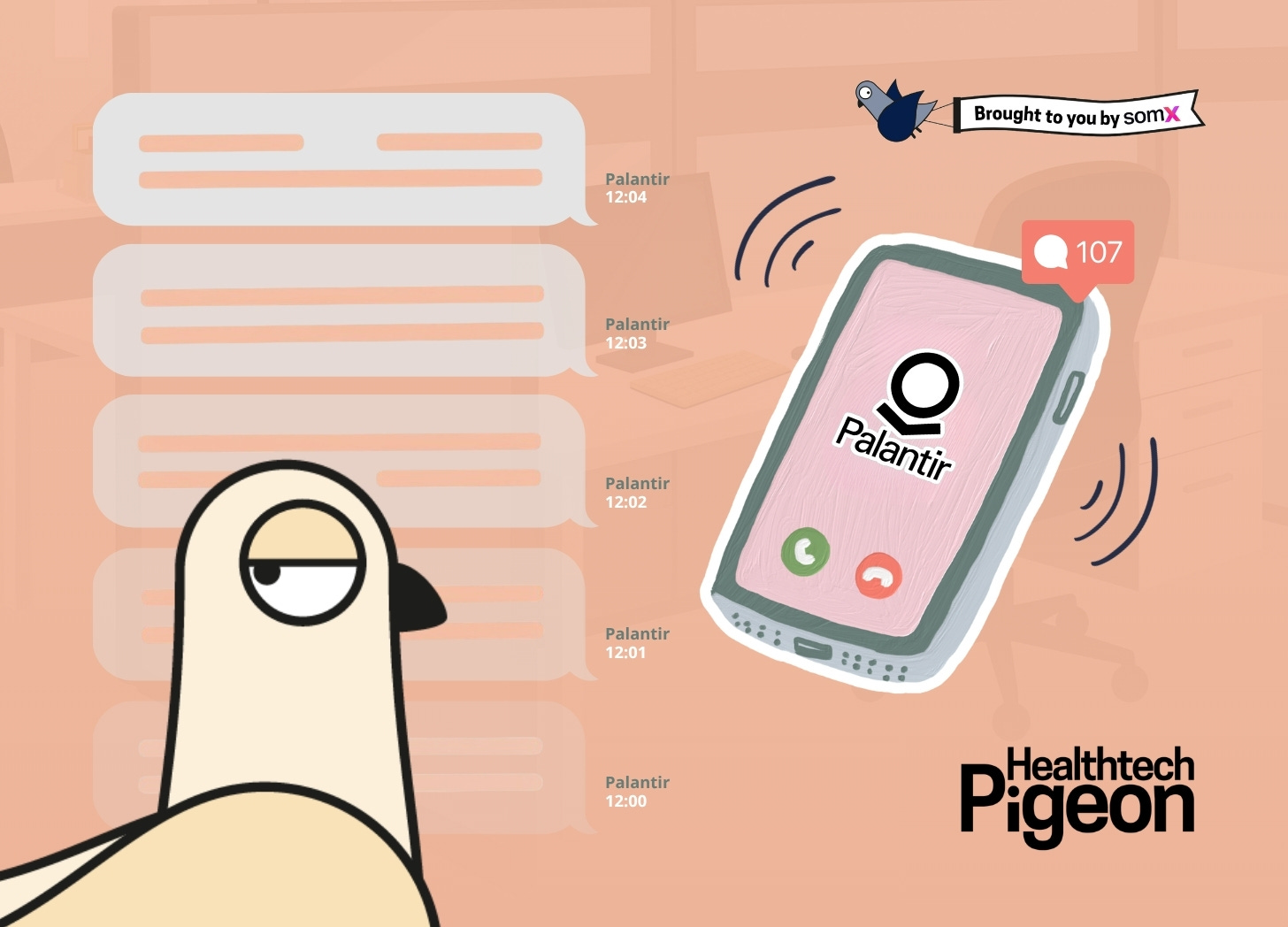
🏛️ Palantir's NHS break clause is suddenly very much on the table: Last week Pigeon brought you Tom Bartlett's spirited defence of the FDP from inside the tent. This week the tent spectacularly caught fire. In a Westminster Hall debate on 16th April, Lib Dem MP Martin Wrigley went full Chuck Norris on the £330m Palantir contract (the system is "awful to use", the NHS owns no IP, it's a "permanent lock-in"). Junior minister Zubir Ahmed (a clinician, to be fair) conceded that the break clause next spring is genuinely being weighed. Wes Streeting was conspicuously absent from the debate. Look, the thesis of the FDP (joined-up data, better outcomes) remains sound, but the execution question was never whether Palantir could build the thing, it was whether a politically radioactive US defence contractor holding all the NHS's IP was a sustainable architecture. Sounds rhetorical. Isn’t.
🩺 The Women's Health Strategy arrived with a £1.5m FemTech fund and a very quotable Streeting line: Wes said the NHS "too often gaslights women,” a sentence Pigeon is still processing from a sitting Health Secretary. The strategy bundles a new National HealthTech Access Programme, a trial linking patient feedback directly to provider funding, a £1m menstrual education programme, a fresh UK–India FemTech R&I partnership, and a £1.5m FemTech challenge fund to accelerate NHS adoption of women's healthtech. We’re genuinely glad this exists, but the fund size is awkward. Take France's Femtech Île-de-France launched in June 2025 with an initial €5m and a €50m target. We've rocked up with £1.5m. Either we think women's health is a priority, or we think it's a "priority."
🤖 Cera launches "world-first" AI Lab for the care sector: Cera’s put an eight-figure bet into a dedicated AI lab drawing on its dataset of 300 billion anonymised patient health insights from 2.5 million home visits a month. Ben Maruthappu's framing is - to save human care, we must automate everything but the human - easily the best one-liner of the week. Falls Prediction AI, care coordinator agents, field supervisor agents are already in deployment. The social care crisis is the NHS crisis that absolutely nobody costs properly. A UK operator with real scale, real data, and a licensing plan to export the tools globally is what good looks like. Watching closely.
💰 Q1 2026 digital health funding hit $7.4bn, and the mega-rounds are eating everything: CB Insights’ State of Digital Health Q1’26 report dropped this week. TLDR - $7.4bn raised, up from $5.9bn in Q4’25, with 19 mega-rounds ($100M+). Median late-stage deal size doubled to $108m. Eight new unicorns minted (the highest single-quarter count in nearly four years). M&A up 47%. The numbers that actually stopped Pigeon mid-biscuit: only 2.4% of FDA-approved AI medical devices have randomised trial data supporting them, and fewer than 20% of enterprise healthcare datasets are AI-ready without significant prep. Capital is moving roughly ten times faster than the evidence. Unlikely to end well. If you’re wondering where all the seed stage buzz is, well, the ‘mega rounds’ accounted for 60% of all capital.
📱 The NHS App isn’t actually making patients feel more heard, says King’s Fund: New King’s Fund report found no statistically significant difference between NHS App users and non-users on how well the NHS communicates with them. In 2024, App users were more positive. That delta’s now collapsed. The 10 Year Health Plan positions the App as the future “front door” to the NHS, which is fine, except the tenant hasn’t moved in (yep, I’ve stretched that metaphor). NHSE’s response was essentially yes, we know, that’s why we’re investing more. Remember, folks… digitisation ≠ transformation. A digital front door into a broken corridor is still a broken corridor. I’m definitely not bringing strong metaphor game today.
🧠 brainjo raises €2m to put VR psychotherapy on prescription for kids with ADHD: The plan here is to get DiGA status (Germany’s prescribable-and-reimbursable digital health app framework) for a VR-based ADHD therapy for 8-13 year olds. They have a clinical study already running with around 100 children and they’re targeting market approval in 2028. I feel like it’s been a while since VR was all the rage, but it’s never really gone away and I’ve spoken to Ross O’Brien and Sarah Ticho recently on the Pigeon podcast about it if you’re interested. For brainjo, a proper clinical study and a strategic pharma partner should separate it from the pack.
And finally…
📊 Stanford and Harvard’s State of Clinical AI 2026 is the reality check the sector needs: Turns out, if you take the most-cited clinical AI studies from 2025 and ask: does any of this actually improve care once it leaves the lab? The answer (depressingly often) is “not yet measurable.” Here’s the actual report. The argument is that the speed of academic publishing now lags the speed of model deployment so greatly, we really should just be focusing on outcomes that matter in real-world care. The CB Insights funding report above shows capital pouring in while the evidence base is still struggling to keep up. “It was the best of times. It was the worst of times.” And repeat.

A BRAND NEW newsletter - for clinicians, by clinicians 📚
Clinicians, are you looking for somewhere to shoot the shift? Yep, thought so, because working in clinical practice is a ‘unique’ experience and those that get it, get it. Introducing Shift Happens, the monthly newsletter for clinicians, by clinicians. Free, no fluff, plenty of memes and smattering of lessons that fellow clinicians have learned along the way. Read the first edition here. And subscribe there 👇

What to listen to 🔊
Ahmed from the Health Foundation and I chat through survey data on what Britain actually thinks about AI in healthcare. It won’t surprise you that the people who stand to benefit most are the most sceptical.
AI-driven risk prediction, organ-specific aging clocks, GLP-1s, and the case for prevention over cure. Big prevention themes at the minute - listen to this after reading Pigeon Insider and you have yourself a fantastic evening.
What has to actually work for clinical AI to stick? The a16z team chat through workflow integration, value-based care, trial design. Keep the State of Clinical AI 2026 report from above in mind, and the CB Insights number that 2.4% of FDA-cleared AI devices have RCT data behind them. The money’s moving. The evidence isn’t.
Events 📅

The Future of Prevention: Who Pays, Who Delivers, Who Benefits?
🗓️ 28th April
🇬🇧 Hale House, London
SomX and Neko Health are convening a closed-door, Chatham House Rule evening for senior leaders from the NHS, policy, government, investment, and the healthtech industry to grapple with the prevention agenda - who actually pays for it, who delivers it, and who benefits. Features a fireside between Neko’s Hjalmar Nilsonne and Dr Nikita Kanani MBE, hosted by yours truly (Dr James Somauroo). Not a product pitch, not a sales event - just the right people in the right room having the difficult conversation. Places are very limited (120 max) so make sure to apply ASAP.
📋 Hardian Health Tech Summit 2026:
📅 29 April 2026
🇬🇧 BMA House, London
The annual no-hype, high-substance day on getting regulatory-authorised healthtech to market, with speakers from MHRA, FDA, NICE and Notified Bodies. £50 including lunch and drinks. If you’re building anything that needs a CE mark or 510(k), this one pays for itself before the coffee break.
🏥 The NHS Strategy Summit 2026
📅 30th April 2026
🇬🇧 County Hall, Westminster, London
Senior NHS leaders, ICB executives and industry innovators converging on Westminster for a day of debate on AI, digital transformation, workforce and neighbourhood integration. Sir James Mackey headlines. If you want to know where NHS strategy is heading in 2026, this is the room.
🌏 4th International Conference on Global Healthcare and Medicine:
📅 7–8 May 2026
🇲🇾 Kuala Lumpur
A two-day, 25-track gathering covering everything from oncology to e-health, aimed at clinicians, researchers and policymakers from across the region. If you want a passport stamp with your CPD points, here’s your excuse.
HLTH Europe 2026
🗓️ 15–18 June
🇳🇱 RAI Amsterdam
Europe’s #1 healthcare innovation event, 5,000+ leaders from 50+ countries, and SomX will be there in force. Pigeon will be Pigeoning, and there might be a SomX satellite event to announce soon.
Opportunities for startups 🕵️♀️
🏥 Social Impact Accelerator - BCG X: Calling all startups… BCG X is offering 8–12 weeks of free product-building support - engineers, designers, strategists, no equity - to founders and teams working on digital, AI, or analytics tools for frontline health workers. Two committed team members and a working concept is all you need. Apply.
💰 Up to £100k for MSK startups from Orthopaedic Research UK: The Ronald Furlong Fund is open again for 2026, and it's a rare beast. Cash for pre-seed/seed startups working on bone, joint and muscle wellbeing. AI and digital health, biomaterials, prosthetics, osteoarthritis, fracture care, paediatric MSK, the lot. Stage 1 is a five-minute Loom pitch (no written application, no polish required), a refreshingly humane way to open the door. Deadline's 22 May.
Jobs for humans 🕵️♀️
💻 Lead Frontend Engineer, Accurx: Accurx are used by 98% of GP practices in England and send over 200,000 messages between clinicians and patients every single day. React shop, TypeScript, Shoreditch office three days a week, salary £75-105k plus meaningful share options. If you’ve led a frontend function before and you’re itching to do it somewhere that moves the needle on NHS care at actual scale, this one’s for you.
🧭 Head of Product, Patchwork Health: Patchwork’s tech is used across 200+ healthcare organisations and 100,000+ clinicians, and has saved the NHS £180m+ in workforce costs. They’re looking for a senior product leader to own the next phase. London, hybrid, remote-first culture. (Bonus context: cofounder Dr Jing Ouyang was on last week’s Pigeon Podcast - so if you want a sense of the vision before you apply, start there, then move onto Jing’s very own podcast, Out Of Programme)
🤖 AI & HQ roles, Cera: Off the back of this week’s AI Lab launch, Cera are hiring across data science, engineering, clinical and operational roles. If the idea of building AI tools on top of 300 billion patient data points with distribution across two-thirds of NHS care regions sounds like the right size of problem. Rare UK healthtech role where scale isn’t aspirational.
🛡️ Patient Safety Manager, Neko Health: Neko’s preventive health scanner is one of the more serious new entrants in the UK consumer clinical space, and as the clinics scale across Europe and the UK, patient safety becomes the most important role nobody talks about. If you’ve got NHS or regulated-provider safety chops and you want to build safety-by-design into a fast-moving healthtech from the ground up, this is a good one.
📣 Want something in front of our 7,500+ readers?
You can break your news as the main story, feature a podcast, job or event... and we even have a few sponsorship packages to choose from...
We review everything editorially - if it is not right for our audience, we’ll let you know. Everything has to be valuable to this glorious community.
See you next week, Pigeon fans ✌🏼

Healthtech Pigeon is produced by SomX - the media-led communications and creative agency for healthcare. We help healthtech, biotech, pharma and public sector organisations tell sharper stories through strategy, PR, content, design, events and media production. Built by clinicians, scientists and creatives who know the space. Work with us.