



Hi friends,
What a week. OpenEvidence gone. Medtronic hacked. Heidi hardwared. Settle in, lots to get through - bumper edition with all sorts of useful links this week.
Q: 🎙 Fancy this newsletter in podcast form?
A: Click this linky link to get the pod on Spotify. And it’s on the SomX YouTube channel if you like to look at the faces of people when they talk.
Good news (literally). Pigeon Insider has launched.
Free Pigeon stays free. Insider is where I put the stuff I can’t publish to 8000 people - the off-the-record conversations, the bets I’d actually make, the things I hear outside recordings. If you’re building, investing, or operating in healthtech, this is the edge.
* This is the last week the offer runs. Get it today or else.
News Bites 🥪
🚪 OpenEvidence withdraws from the UK and EU, citing AI Act uncertainty: This a really important one because it’s kind of the opposite of what a lot of people wanted and it feels like things have gone backwards. A whopping 40% of US doctors use OpenEvidence and they’ve now pulled it from the UK and the EU because of ‘regulatory uncertainty.’ A tool that’s well-evidenced (NEJM and AMA partnerships), demonstrably useful and free at the point of clinician use, has decided the UK/EU compliance pathway is too murky to bother with. We’re now in the awkward position where well-resourced US clinical AI companies are choosing not to deploy here, not because we’re regulated, but because we’re regulated unclearly. Important difference.
🧬 ICR's PhenMap AI tells you who won't respond to NHS bowel cancer drug: Bevacizumab (an angiogenesis inhibitor, for those interested) finally made it onto the NHS for bowel cancer last December, BUT… most patients won't benefit from it and the side effects (high blood pressure, GI problems, blood clots) are no joke. Enter PhenMap, an AI tool from the ICR and RCSI Dublin that scores patients on how likely they are to benefit, plus a second AI flagging mortality risk. It’s early days (built on data from 117 patients so far), but the BRAF mutation signal it picked up is exactly the kind of thing ‘precision oncology’ has been promising for a while (decade at least). If it validates in larger cohorts, we could be sparing thousands of people unnecessary side effects and sparing the NHS cash that it spends elsewhere. Win-win, in theory.

🛡️ Brunel’s RADIANT CERSI is giving UK healthtech startups a clearer, faster route through regulation
Imagine cutting months off your regulatory timeline, sidestepping the most common SaMD and AIaMD pitfalls, and walking into Conformity assessment submission with the same playbook the experts use - for FREE. That’s the offer RADIANT CERSI (Centre of Excellence for Regulatory Science and Innovation) is quietly putting in front of UK digital health founders, and it’s one of the most useful things to happen to the ecosystem in a while.
If you were in any doubt about their credentials, the Brunel-led Centre of Excellence in Regulatory Science and Innovation is backed by £1M from Innovate UK, MRC, MHRA and the Office for Life Sciences and it brings together UCL, KCL, Imperial College NHS Trust, BMJ, Zinc and the Health Innovation Network South London.
They’ve already taken 65 companies through 9 expert-led workshops covering clinical evaluation, QMS, post-market surveillance and the full regulatory toolkit. The RADIANT CERSI programme developed to specifically create (genuinely) usable tools to help all of you lovely startups orient, upskill and implement regulatory laws, standards/guidance.
This is what we need. Rigorous, academically-grounded, SME-friendly, and aligned with the 10 Year Plan’s “analogue to digital” shift. The best bit? Resources from the first cohort are now open-access on the RADIANT site, so any founder building a SaMD or AIaMD product can benefit immediately. Worth a proper look. Your future regulatory affairs lead will thank you.
Keep an eye out for a follow-up RADIANT CERSI panel discussion at Hale House this summer - the exact date TBC. Pigeons will be first to know.
🇬🇧 Boehringer Ingelheim plants a £150m AI flag in King's Cross: After MSD walked away from its £1bn UK plans last September in a public sulk about the government's life sciences ambition, the sector's been quietly hoping someone would show up with good news. Enter Boehringer Ingelheim, opening a new AI and ML site in King's Cross as part of a £150m, 10-year R&D bet. The pitch sounds familiar… better understanding of patient journeys, faster identification of disease mechanisms, smarter drug discovery… and they're aiming for 50 AI experts in place by end of 2027. With the London Cancer Hub's $1bn Sutton expansion in February as well, the "London as global life sciences hub" line is starting to sound less like a slogan and more like a plan. Lord Vallance is, predictably, delighted.
🔓 Medtronic got hacked, but don't worry about your pacemaker: Can a pacemaker even get hacked? Anyway, Medtronic have confirmed an unauthorised party rummaged around in its corporate IT systems. The reassurances are coming thick and fast, as you’d expect. “Products unaffected, patient safety unaffected, manufacturing unaffected, hospital networks separate, financials unaffected.” Genuinely good news, if true. The alternative is a horror story. Still, "we don't expect a material impact" is the kind of line you write on day 1 of an investigation, not day 90, and they're still working out whose personal data went for a walk. One to watch. Especially if you have a pacemaker. No, wait, they’re fine, right?
🎙️ Heidi clips a microphone to your collar (and quietly ditches the cloud): A bit late to this one, but the more we've sat with it, the more interesting it gets. Remote is a 21g wearable mic that clips to your scrubs and, crucially, transcribes on the device itself. No phone propped between you and the patient, no audio streamed to the cloud mid-consult, 14 hours of battery, works without Wi-Fi. So for psych, sexual health and paeds clinicians who've refused to touch a cloud scribe, on-device transcription changes the vibe pretty significantly. It also lands neatly into NHS England's updated BYOD guidance and the recent priority notification on AI scribes.
💷 Calibre exits stealth with $3.3M to do “causal” preventive health: With our Neko event this week, prevention is on-the-brain so I’m not surprised to have spotted this round. Interesting, this is a freshly minted category called "Causal Health Navigation". Wtf does that mean, I hear you ask? Well, ‘causal AI’ plus a clinician-led model tells you why a health metric is moving, not just that it is, which is a more rigorous alternative to the 230m people a week apparently now asking ChatGPT for health advice. Founders are ex-N26, ex-Elvie, ex-Manual, so the consumer-scaling chops are real. Does "causal" means something genuinely different? Or is it the new "personalised" doing rhetorical heavy lifting until an outcome study lands?
📱 The NHS App Just Quietly Did the Thing Everyone's Been Asking For: Hospital patients in England can now see their appointments in the NHS App. Letters, dates, locations, the lot, all in one place, finally. It's the kind of update that, on paper, removes the daily admin pain of "did that letter come, or did the dog eat it?" NHS England reckons it'll save millions of paper letters a year and cut down on missed appointments. Which is all well and good, except last week's King's Fund report found the App isn't actually shifting patients' views on NHS admin one bit. Features are landing. Sentiment isn't. Worth us asking why.
What to listen to 🔊
This week I sat down with Dr Clare Palmer, Director of Evidence Generation at ieso, to dig into what genuinely safe, clinical AI for mental health actually looks like, and why purpose-built, safety-constrained architecture is a different planet from people venting into ChatGPT. And here’s something NEW and fun 👇
What do investors look for? How do you sell into the NHS? Is now a bad time to raise? Answers are buried in 450+ episodes, nobody’s listening to 600 hours of audio to find them, so I (AI) made a thing. Type a question, get an answer in <10 seconds, with a link to exact episodes where the thing was talked about. Click any link and the episode opens to exactly when the guest said it in Spotify. It’s free. No signup or any of that nonsense. Just a search bar and results. Lmk what it gets right and wrong.*
This is fantastic. The first in Tjasa’s new series on how real patients are quietly using AI to navigate their care (often) without telling their clinicians. Dale Atkinson, a former financial crime investigator with a terminal diagnosis, brings a heck of a forensic eye to medical literature. A genuinely important listen.
A techy one for you. Pete chats to Sean Walker, CTO of Alcidion, to dig into the architecture decisions behind clinical AI platforms - TGA certification, human-in-the-loop, and why “context engineering” is replacing prompt engineering. A grounded, builder’s-eye view of the trade-offs.
Events 📅
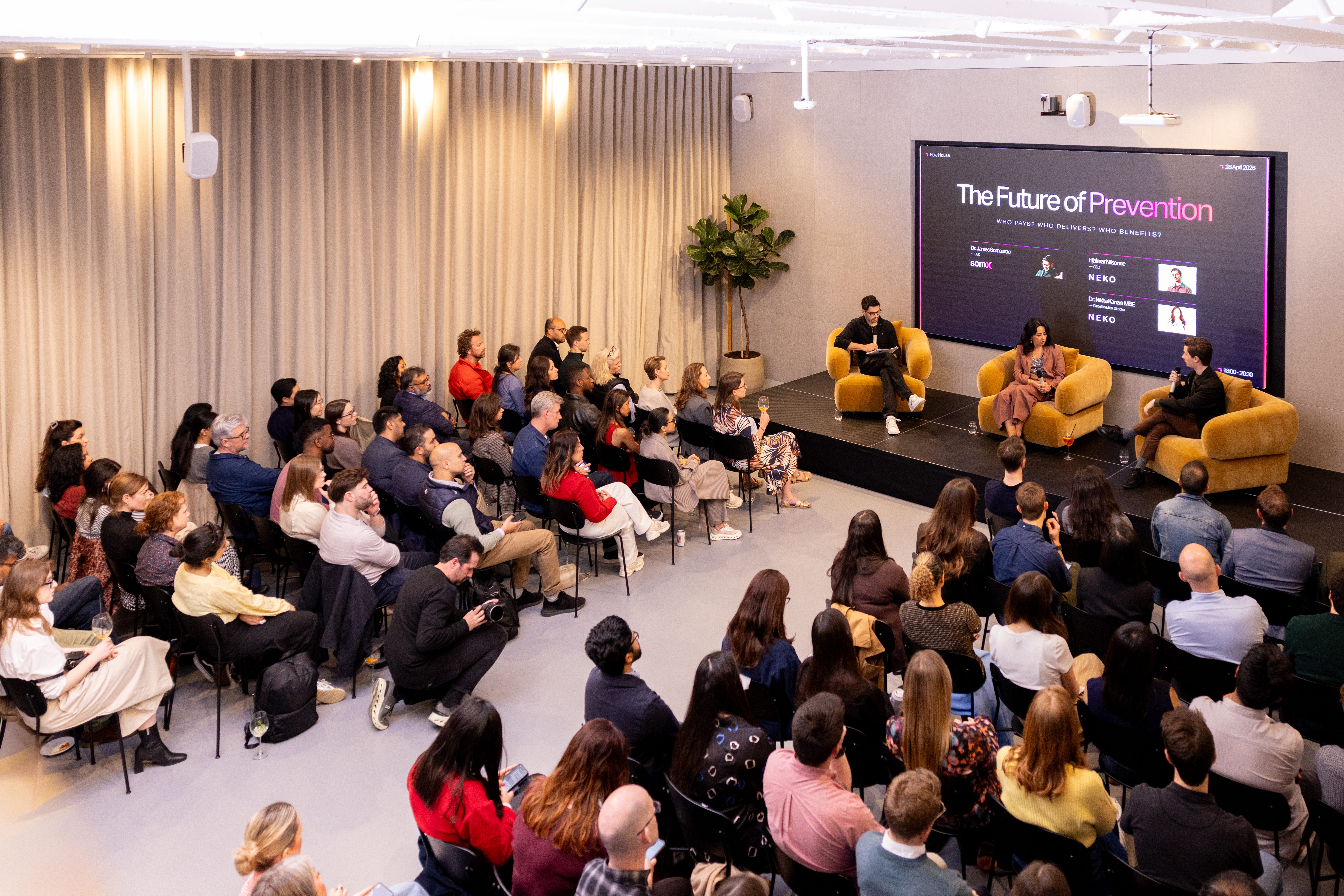
🎉 Quick mention before we get going… what a Tuesday night. We (SomX) and Neko Health packed Hale House for a closed-door debate on The Future of Prevention: Who Pays, Who Delivers, Who Benefits? There was a fireside with Neko co-founder Hjalmar Nilsonne and Global Medical Director Dr Nikita Kanani MBE, hosted by yours truly and the room was stacked with a mix of NHS leaders, government, academia, employer health teams, investors and media all in one space, asking difficult questions about prevention at scale that (let’s be honest) don't usually get aired in public.
Thanks to everyone who attended and made the atmosphere what it was. The next Pigeon Insider (the upgrade to free Pigeon) will be a deep dive on my thoughts and what founders, investors and the NHS should know. Last chance to get the offer 👇
📊 Blind Data
📅 6 May 2026, 12:30pm
💻 Online
Great name. Coplug’s lunchtime panel on neighbourhood-level data and what’s missing from the NHS’s data plumbing. A useful counterweight to the “just put it in the App” school of thinking.
🌏 4th International Conference on Global Healthcare and Medicine:
📅 7–8 May 2026
🇲🇾 Kuala Lumpur
A two-day, 25-track gathering covering everything from oncology to e-health, aimed at clinicians, researchers and policymakers from across the region. If you want a passport stamp with your CPD points, here’s your excuse.
📊 Digital Health Festival 2026:
📅 20–21 May 2026
🇦🇺 MCEC, Melbourne
APAC’s biggest digital health gathering - 5,000+ attendees, strong on government digital strategy and the My Health Record saga. Pigeon hears Australia is lovely in May.
🏗️ Pathfinder Digital Transformation Summit:
📅 2 June 2026
🇬🇧 88 Wood Street, London
Pathfinder’s CIC summit pulling together NHS digital leaders, vendors and policy folk on what “transformation” actually means once the consultants leave the building.
📈 From Records to Results: Unlocking Healthcare Through Data:
📅 5 June 2026
🇬🇧 RSM, London
The RSM’s data-focused day - how trusts are turning EHR exhaust into actionable analytics, with case studies from teams who’ve actually shipped something. Practical rather than theoretical, which is rarer than it should be.
🇳🇱 HLTH Europe 2026:
📅 15–18 June 2026
🇳🇱 RAI Amsterdam
The big one. Pigeon will be Pigeoning, potential SomX satellite event TBC. If you’re only doing one European healthtech conference this year, make it this one.
Visit the SomX events page or subscribe to SomX’s events roundup for everything else.
Jobs for humans 🕵️♀️
🛡️ Clinical Associate, Assuric: Assuric is the London-based digital health compliance platform that’s become a go-to for healthtech startups trying to navigate DCB0129, DTAC and the rest of the alphabet soup. They’re hiring a Clinical Associate: a clinical brain to sit alongside their team of Clinical Safety Officers and help startups get through compliance without losing the will to live.
🐢 Full-Stack Engineer, TORTUS: TORTUS, first ambient AI to land DTAC compliance in the NHS, deployed at GOSH and across UK primary care, is hiring full-stack engineers to scale OSLER. UK clinical AI you can actually ship into the NHS at speed. If you want to build the kind of system that wouldn’t have to leave the country to operate, this is one of the most exciting teams to do it with.
🎙️ Clinical Associate - Growth, Heidi: On the back of this week’s Heidi Remote launch, Heidi is hiring a part-time Clinical Associate to sit at the intersection of clinical practice and GTM, and lending clinical credibility to commercial conversations. If you’re a UK-registered clinician who wants to keep the day job but get inside one of the fastest-scaling healthtech companies in the world, this is a properly clever way in.
📣 Want something in front of our 7,500+ readers?
You can break your news as the main story, feature a podcast, job or event... and we even have a few sponsorship packages to choose from...
We review everything editorially - if it is not right for our audience, we’ll let you know. Everything has to be valuable to this glorious community.
See you next week, Pigeon fans ✌🏼
James’ editor notes:
* On the build, please forgive the SaaS name dropping as if I speak Silicon Valley Tech Bro fluently, but I’ll list it all out and hyperlink so you can look them up if interested… Also Claude basically told me to use all of these in this order, so you really can just start with a prompt that says you want to build X and be talked through it. So, Deepgram transcribed 600 hours of audio in an afternoon (I think you have to do this as a podcaster because that’s your basic data for whatever AI keeps evolving into - someone else will do it on your podcast if you don’t - they still might anyway tbh). Voyage embedded the transcripts. Postgres + pgvector handles the semantic search. Claude does the synthesis under a tight system prompt that encodes The Healthtech Podcast’s voice (no "leverage", no "ecosystem", no rule of three etc). Lovable did the frontend (leaves a lot to be desired, but it’s a start and it’s functional). Supabase Edge Functions glue it together. Re: costs… about $90 to transcribe everything, $0.005 per query. We're now firmly in the era where one person can ship production software in a weekend by orchestrating models, and I suspect that the businesses that will compound from this are the ones built on proprietary editorial IP. That's what the pod is, and this is a lot of what SomX is becoming.

Healthtech Pigeon is produced by SomX - the media-led communications and creative agency for healthcare. We help healthtech, biotech, pharma and public sector organisations tell sharper stories through strategy, PR, content, design, events and media production. Built by clinicians, scientists and creatives who know the space. Work with us.