



Hello healthtechies.
I’d count to 10 before you read the first one this week. The optimism kicks in after that.
Enjoy.
James.
News Bites 🥪
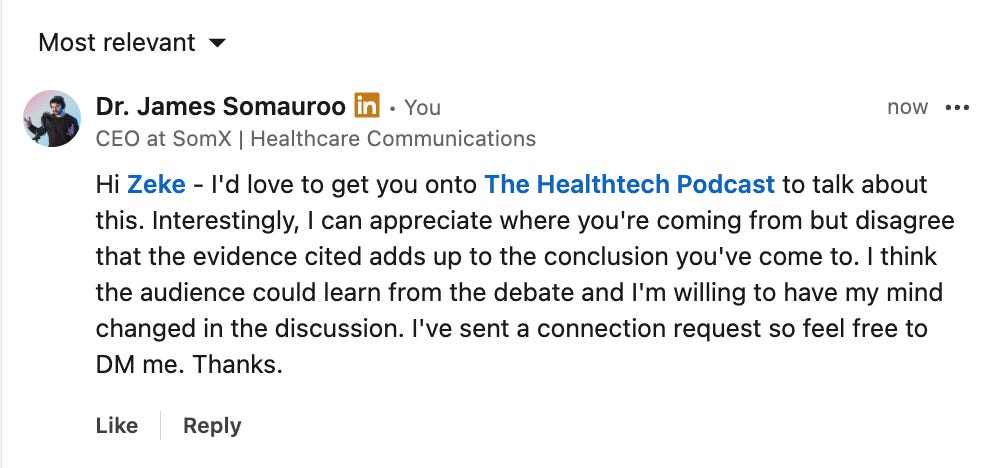
🤖 Autonomous AI should replace doctors, argues bioethicist and VCs: Ok deep breath… TLDR, a JAMA paper’s argued that ‘AI-only care’ will outperform ‘human-AI teams’ by 2030. Hmm… The authors? Bioethicist Ezekiel Emanuel and Curai Health's Neal Khosla (son of Vinod Khosla, a VC and early OpenAI backer with a massive stake in raising the enterprise value of AI companies by saying things like “‘AI-only care’ will outperform ‘human-AI teams’ by 2030”…). My opinion? Well, I disagree, along with many others in the comments section. Their evidence? Shaky, reductive, ill-understanding of the context of medicine if you ask me. If pushed, I’d say a big swing and a miss, and kind of insulting to healthcare workers as a powerful, loud, uninformed minority often dismiss people’s vocations and disrespectfully speculate on their livelihoods. Transiently dropping into healthcare to push a certain narrative (that completely changes the fabric of the industry, by the way) when you have a clear financial incentive is so obviously wrong, it’s like a caricature of an ethics scenario. Do I think healthcare will move to some AI-only pathways? Actually yes at some point. But articles like this won’t speed that up. Respectful, innovative entrepreneurs and healthcare professionals will.
I’ve invited them onto the podcast for a genuinely open minded chat.
🖥️ Dame Caroline Clarke to be NHS Online CEO: When I started in what is now healthtech, the thought we’d have an entire trust existing inside an NHS App would have been incomprehensible. I know I lean into cynicism for comedic effect in this newsletter a lot, but I did just find myself having a little reflective moment. We’re doing ok in the sector guys. Anyway it now has a chief exec and it’s Dame Caroline Clarke. If you don’t know her, she started her NHS career as a finance trainee in 1991, was Finance Director at multiple NHS Trusts and an Associate Partner in KPMG’s health strategy team, formerly group CEO at the Royal Free and currently Regional Director for the NHS in London. Heck of a CV and the task is to build the trust from scratch ahead of a 2027 launch. GPs will be able to refer into it for glaucoma, IBD, iron deficiency anaemia, prostate conditions, and menopause and menstrual issues (all areas where waits are long and the evidence for remote care is reasonably strong). Would LOVE to get Dame Caroline onto The Healthtech Podcast so we can all learn what’s going on over there - if anyone can do an intro let me know!
👩🔬 61 women, £75k each, and a decade of shifting the numbers: Innovate UK’s Women in Innovation programme has its 10th cohort. 100 female founders, 61 get £75k and a year of business support, the rest getting the support without the cash (bit harsh). The projects range from wearables that spot dehydration risk, AI that cuts MRI scan time by up to 90%, smart pressure sensors woven into everyday textiles, RNA therapeutics aimed at the biological drivers of Parkinson’s and loads more, obviously. Since 2016, £15m has gone into companies that have gone on to raise £358m, and the share of successful women-led applications across all Innovate UK competitions has moved from one in seven to one in three. Ideal. More to do.
🧫 Britain’s growing tiny organs so mice don’t have to: A £20m MRC-funded hub in Cambridge is going to build a standardised, validated library of organoids (mini organs) grown from NHS patient cells and it’ll be open to academics and industry to do things on/with/to. Over 90% of drugs that clear animal testing go on to fail in humans, and as Matthias Zilbauer puts it, ‘a mouse can’t tell you which treatment works in which patient.’ Yep. First up are organoids for ulcerative colitis and Crohn’s, with tumour and brain models following, and another £2m from Innovate UK’s going into 9 safety-testing projects like VivoSphere’s heart cells in gel spheres. Nobody’s claiming animal use ends here, but 2.54 million procedures were carried out in Britain last year, and it’s a step in the right direction.
🩸 Your glucose data is moving in with Gemini: Abbott’s Lingo CGM’s plugging into the Google Health app for all the usual ‘better advice’ stuff you’d expect, but there’s also the largest real-world metabolic health study ever brewing. It’ll combine those continuous glucose readings with wearable, lab and survey data, with the findings feeding back into the coaching. Lingo’s over-the-counter, for adults not on insulin, and explicitly not a diagnostic, which, let’s be honest, blurs as soon as an AI starts telling you what your numbers mean. Google’s own caveat is that the coach isn’t for medical purposes and you should check its answers... Study? Valuable. Coaching? Not sure. Yet.
🍷 Ozempic did it for food, naltrexone might do it for alcohol: Despite being one of the biggest preventable causes of harm in the UK, alcohol’s largely been left without a major support movement. Nul’s raised $1m to change that, building a remote subscription service around naltrexone and The Sinclair Method, where you take the pill before you drink and let the brain's reward pathways gradually lose interest. Reduction-not-abstinence is the framing, which opens the door to the enormous group of people who know they're drinking too much but would never walk into a service labelled addiction. 120 paying customers is a good start to show it’s valuable.

This week’s Pigeon Insider tells you literally everything you need to know about the FDP. And I’ll be honest - I didn’t know much about it at all before I started, so I spoke to someone who built it, did a podcast and wrote this thing here.
Enjoy 👇🏼

What to listen to 🔊
This is the chat that informed the article above for Pigeon Insider. Everything about the FDP. Enjoy.
Martin Ratz co-founded Doccla after a heart attack. Lying in a hospital bed in Stockholm, he noticed that inside the building you’re monitored constantly, but the minute you leave, nobody’s watching. Why? No good reason. Did he change that? Yes.
Ellyn Winters-Robinson was diagnosed with breast cancer in March 2022, months before ChatGPT existed, and wrote a book about it on her iPhone during chemo. That book became AskEllyn, an AI companion for cancer patients now used in a hundred countries. Yet, she's the one telling patients not to upload their records to LLMs.
What happens when a South African anaesthetist survives cerebral oedema on Everest, bootstraps an NHS appraisal platform with no external funding, and sells it to one of the UK's fastest-growing health tech companies? 👆🏼 That.
Events 📅

Get ready for this one. Yes, that’s exactly who you think it is…
SomX Healthtech Talks: Will the NHS waste the AI moment?
🗓️ 2 September
🇬🇧 Hale House, London.
We’re back. And this time, we’re bringing the Rt Hon Sir Jeremy Hunt who served as Chancellor, Foreign Secretary and Secretary of State for Health and Social Care. He’s joined by myself (Dr James Somauroo), Tara Donnelly, one of the NHS’s most respected digital leaders and former Chief Digital Officer at NHS England, and Jack Needham, cofounder of Sanctuary Health, bringing AI to the NHS. I want to get to the nub of where AI can tangibly make a difference in secondary care, where it’ll disappoint, and what it’ll actually take behind the scenes for the health service to truly seize the day. Expect Chatham House Rule, real opinions and stories never heard.
HealthVC Summit 2026
🗓️ 2-3 September
📍 🇨🇭 Zurich.
Two days connecting health investors and founders across Europe, China and Saudi Arabia. If you’re raising, this is where the cheque-writers gather.
Longevity Investors Conference 2026
🗓️ 14-17 September
📍 🇨🇭 Gstaad.
Family offices, funds and private investors in a ski resort, talking rejuvenation science with the people doing it. Heavy on capital, occasionally light on endpoints, but the money moving into longevity is real and worth watching.
Mental Health Innovation Showcase, Hale House
📅 15 September
📍 🇬🇧 Hale House, London.
MHIN’s showcase returns to the Harley Street Health District for a full day (noon to 9pm, so pace yourself) of mental health innovation. Given how much of this space still runs on vibes rather than evidence, worth your time.
Life Sciences Week 2026
🗓️ 21-25 September
📍 🇬🇧 Birmingham.
Britain’s national life sciences week, pulling biotech, medtech, pharma, academia and investors into one place. A proper cross-sector convening rather than the usual echo chamber.
LSI Europe ‘26 Emerging Medtech Summit
🗓️ 28 September-1 October
📍 🇪🇸 Barcelona.
Europe’s leading emerging-medtech investor summit, matching founders with VCs, PE and strategics. Sunny, well-connected, and squarely aimed at getting deals done.
HETT Show 2026
🗓️ 29-30 September
📍 🇬🇧 ExCeL, London.
Three thousand-odd NHS digital and clinical leaders, 150 suppliers and five CPD streams under one roof at ExCeL. If you want to know what trusts are actually buying rather than what vendors wish they were buying, this is the one.
Harley Street Health District Conference 2026
📅 20 October
📍 🇬🇧 1 Wimpole Street, London.
A full-day conference from the district becoming one of London’s biggest healthtech hubs.
Visit the SomX events page or subscribe to SomX’s events roundup for everything else.
Opportunities 💰

🧬 Customer Success Manager, StoreGene: StoreGene sequences your whole genome once and then keeps reanalysing it as new variants get discovered, so a sample taken today can still be answering clinical questions decades from now. The role sits alongside the Head of Clinical Success, finding and onboarding clinics, explaining genomic use cases to sceptical clinicians, and keeping kits, samples and reports moving without anything going missing. Good one if you've got a science or clinical background and fancy being the person who actually gets genomics into clinics. ⭐️ Featured Role ⭐️
🏥 Chief Digital Information Officer, Great Ormond Street Hospital: Running digital, data, ICT and AI across the whole Trust, reporting to the COO. VSM pay, permanent, closes 11th September. You’d own the digital strategy, the cyber posture and the AI governance framework.
🩺 Clinical Engineer, Anima: Anima does care navigation for 20% of the population. The ask is a medical degree and the ability to actually ship code, TypeScript and React on serverless AWS. £75k to £150k plus equity, London hybrid. If you’re a doctor who quietly prefers the engineering to the clinic, this pays you properly for both.
📋 Clinical Evaluation Specialist, Scarlet: Scarlet is the approved body doing medical device and AI conformity assessment. You’d spend your days pressure-testing whether the clinical evidence supports the claim. £75k to £90k plus equity, London. Clinicians who know their way around ISO 14155 will never get more leverage over what reaches patients.
☁️ Healthcare Strategic Lead and Clinical Innovation Lead, AWS UK Public Sector Healthcare: AWS is clearly building out its NHS bench. The Strategic Lead (London or Manchester) is business cases that get through Trust CFOs and procurement frameworks. The Clinical Innovation Lead is the clinical half of the same pincer movement, so enough credibility to earn a CCIO’s trust, plus the patience to nurture pursuits over 12 to 18 months in AI pathways, genomics and population health.
📣 Want something in front of our 8,000+ readers?
You can break your news as the main story, feature a podcast, job or event... and we even have a few sponsorship packages to choose from...
We review everything editorially - if it is not right for our audience, we’ll let you know - everything has to be valuable to this glorious community.
See you next week, Pigeon fans ✌🏼

Healthtech Pigeon is produced by SomX - the media-led communications and creative agency for healthcare. We help healthtech, biotech, pharma and public sector organisations tell sharper stories through strategy, PR, content, design, events and media production. Built by clinicians, scientists and creatives who know the space. Work with us.