



Hello healthtechies,
A tale of two halves this week. The two halves being:
AI bad, naughty AI 👎🏼
AI good, excellent AI 👍🏼
We’re trending upwards with it, but it’s not without its scandals.

This week's edition of Healthtech Pigeon is powered by our friends at Sanctuary Health, who are on a mission to make AI actually useful in healthcare. Rather than parachuting in a shiny model and hoping for the best, Sanctuary actually embeds engineers directly inside hospitals, insurers and government teams to build tools that fit real clinical workflows.
Fun fact, Jack, the founder, was the one on stage at this week’s SomX Healthtech Talks event so he’s supporting healthtech left right and centre at the minute.
News Bites 🥪
📝 Doctors’ AI scribes get names of drugs and diagnoses wrong: This is not ok. Someone spent a decent stretch of her life believing she had nerve damage that could lead to MS. She caught it herself, because she happens to work in the NHS, but Healthwatch England has pulled together a load of examples… a drug swapped for a similar-sounding one, a consultant's instruction to get a repeat migraine prescription just vanishing from the letter. In every case the patient spotted it. Hm… clinician-in-the-loop? There are at least 27 different scribes running across the NHS in England and the MHRA has decided they aren't medical devices. Make it make sense.
⚖️ Statistics watchdog says NHS England breached the code over AI triage claim: Another whoopsie. The Office for Statistics Regulation has found NHS England promoted a 29% fall in GP telephone queue volumes from a Sussex AI triage pilot without publishing the underlying data, the figure came from an unpublished internal evaluation, and the preprint on the pilot doesn’t even analyse phone queues. “We have found that NHS England’s statement about the GP practice trial did not meet our expectations under the Code of Practice’s Standards for the Public Use of Statistics, Data and Wider Analysis.” Oops.
🤰 Oxford-based PeriPear has raised £1.2m for birth injuries: In much more positive news, PeriPear is solving for the 90% of first-time mothers that tear during vaginal birth with a wearable device that delivers automated perineal thermotherapy during childbirth, so that’s hands-free warmth designed to help prevent perineal tearing. Co-founded by former NHS midwife Nina van Schaick, who spent 14 years watching the problem up close, and healthtech founder Eviatar Natan. The round was led by HERmesa with more than 50 female investors behind it.
🩺 ChatGPT is now sitting inside your Epic record: In AI dystopia weekly, OpenAI’s now plugged ChatGPT Health into Epic, so that’s one less place to escape it. I joke. I’m all for tech, but I think I’m a little but concerned about the power being accumulated. Anyhoo… clinicians can pull in notes, labs, meds and specialist letters and interrogate them in natural language. It can do pre-visit reviews and build clinical timelines but read-only, they're keen to stress. OpenAI ran 4,300 physician responses across 27 use cases and reports 99.1% were safe. Hm… what’s 0.9% of every interaction in a health system that size? A big number I imagine. Meanwhile they’re obviously fighting lawsuits over near-fatal recommendations, and still says ChatGPT isn't for diagnosis or treatment. Fun times.
💰 Scan.com pulls in $220m to scale its diagnostic imaging API: UK-founded Scan.com has done a $90m Series C with a $130m of debt to grow its API and marketplace for booking outpatient scans. Apparently 900,000+ patients served and $165m of ARR (company’s own numbers). They want to API into independent imaging centres’ systems so employers, health plans and digital health apps can see live scanner availability, upfront pricing and subspecialty fit, then route the report to the right radiologist with results back in 48 hours. In the US, obviously.
🔬 MHRA opens a live NHS testing sandbox with Manchester for AI devices and wearables: Yep. AI-enabled devices, risk stratification tools, wearables and ambient voice tech are getting deployed in real clinical settings and generate evidence as they go, rather than relying on retrospective validation sets. Ideal. First technologies land very soon, with a roundtable and an expressions-of-interest window to follow later in 2026. Every CCIO wants to know if it actually works after the demo. Now they can find out. Do we think the evidence that comes out is portable beyond Manchester? Or would that make too much sense?
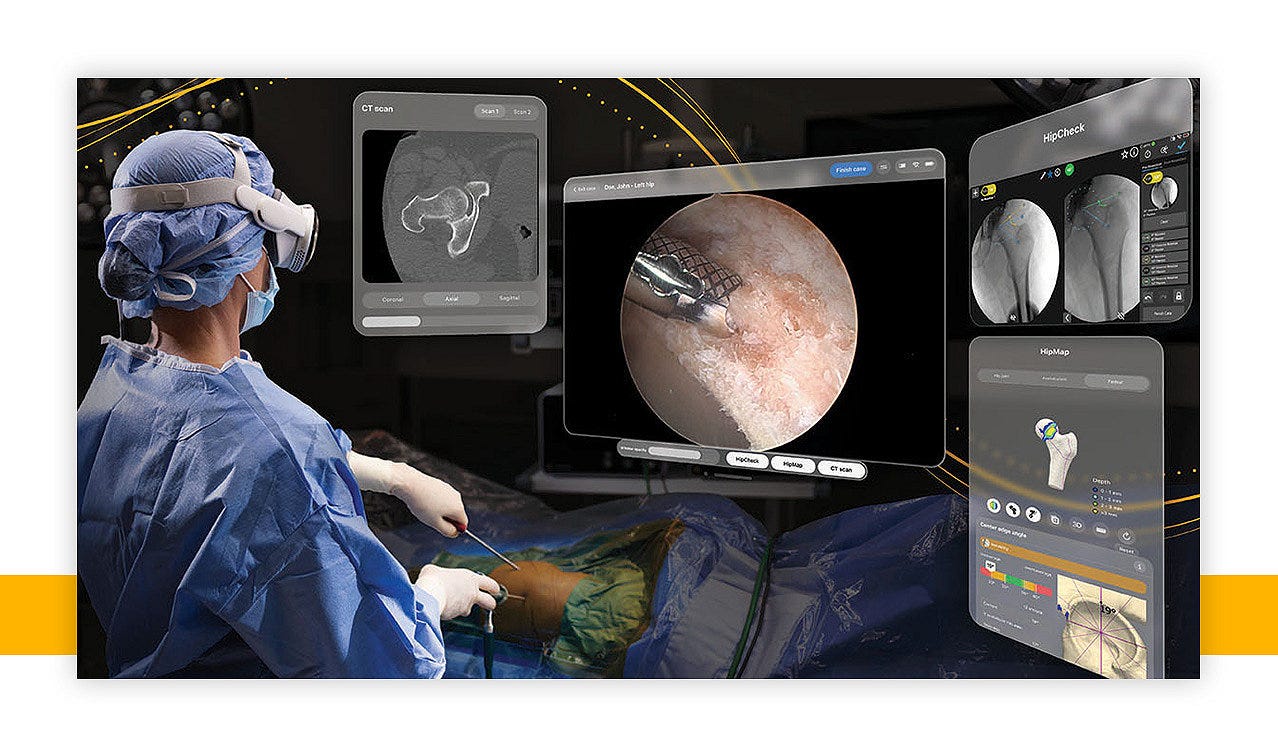
🥽 Someone finally found a use for the Apple Vision Pro, and it's inside your hip: The world's most expensive way to watch YouTube has just been strapped on for a hip arthroscopy at Duke Health. Stryker's SportSuite Vision (the result of a focus group titled “what do we call it so orthopaedic surgeons want to use it”) picked up FDA De Novo authorisation in July, making it the first app cleared for actual intraoperative use with the Vision Pro. It pulls arthroscopic video, CT imaging, HipCheck and HipMap into one field of view instead of the usual scatter of monitors around theatre. Impress your friends and/or sound insufferable by asking people if they’re a fan of “spatial surgery.”
👂 Clementine raises €1.7 million for AI hearing care agent: Hearing loss affects 1.5 billion people and roughly 80% never seek treatment. Those who do typically spent more than 8 years working up to it. That gap is the common constellation of denial, stigma and admin friction, but not clinical capacity for a change, so it’s an interesting one to throw AI at. Matthew (why not call it Matthew I suppose) is an AI hearing care agent that fields patient questions, educates users, overcomes emotional and practical barriers, and guides them toward appropriate care. Basically, judgement-free, always-on, no waiting list, ends in a solution.

🧱 We've Doubled the Doctors and It Still Feels Worse. Why?: Jack over at Sanctuary Health (was on the panel at the Jeremy Hunt do last night), has, predictably gone bold here. The NHS has gone from 2.5% to 7% of GDP and from one doctor per 5,500 people to one per 324, yet access feels worse, because demand is effectively infinite and rises exponentially with age. Abundance doesn't come from more supply, it comes from the cost of supply collapsing, the way sequencing a genome went from $3bn to under $100 in forty years. Crucially, we forgive the harm of doing nothing yet punish the harm of doing something, so a three week wait that lets a cancer grow is normalised, while an AI that's wrong once in a hundred is a national scandal. Ten minutes reading this is ten minutes well spent.
What to listen to 🔊
Our friends Down Under from What The Health and Tenmile have just launched a podcast, and three episodes in, they’re already exploring what Burning Man and the new era of mental health therapeutics have in common. The ineffable Emily Casey gets the lowdown from Dr. Michael Winlo, Chief Scientific Officer of Emyria, on how we’re finally harnessing psychedelics to treat mental health conditions, the science behind it and what it needs in practice to make it work.
Award-winning investigative journalist Deborah Cohen joined me on the podcast this week. Having recently published her book, Bad Influence: How the Internet Hijacked Our Health, which has already been shortlisted for the Royal Society prize, we covered a lot of ground - from regulatory whack-a-mole and anti-vaxxing to GLP-1s, and of course, my Mastermind topic, The Kardashians
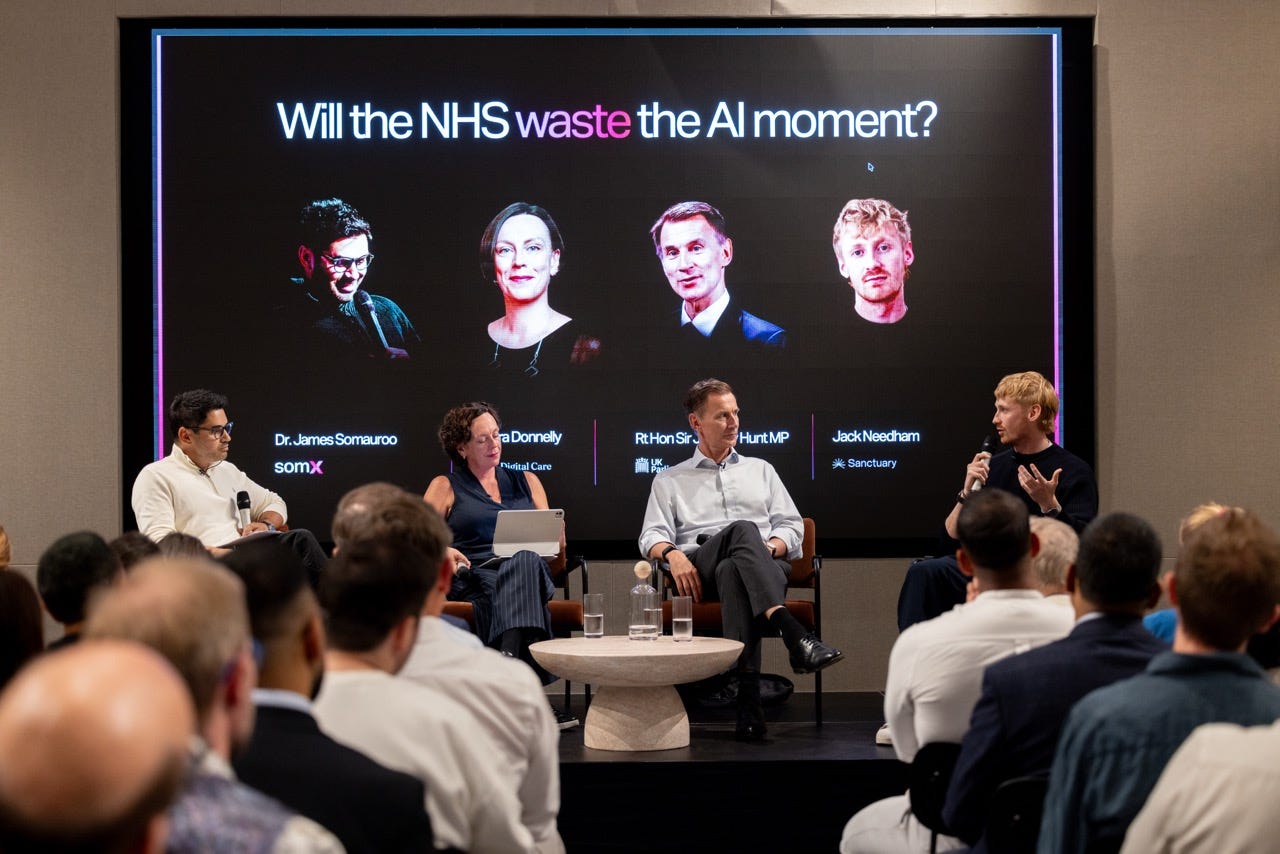
And if you missed us at Hale House for Healthtech Talks this week with Rt. Hon. Sir Jeremy Hunt, Tara Donelly and Jack Needham, I caught up with Jack on the Pigeon podcast for a debrief on our most disagreeable event yet.
Events 📅
Longevity Investors Conference 2026
🗓️ 14-17 September
📍 🇨🇭 Gstaad.
Family offices, funds and private investors in a ski resort, talking rejuvenation science with the people doing it. Heavy on capital, occasionally light on endpoints, but the money moving into longevity is real and worth watching.
Mental Health Innovation Showcase, Hale House
📅 15 September
📍 🇬🇧 Hale House, London.
MHIN’s showcase returns to the Harley Street Health District for a full day (noon to 9pm, so pace yourself) of mental health innovation. Given how much of this space still runs on vibes rather than evidence, worth your time.
Life Sciences Week 2026
🗓️ 21-25 September
📍 🇬🇧 Birmingham.
Britain’s national life sciences week, pulling biotech, medtech, pharma, academia and investors into one place. A proper cross-sector convening rather than the usual echo chamber.
LSI Europe ‘26 Emerging Medtech Summit
🗓️ 28 September-1 October
📍 🇪🇸 Barcelona.
Europe’s leading emerging-medtech investor summit, matching founders with VCs, PE and strategics. Sunny, well-connected, and squarely aimed at getting deals done.
HETT Show 2026
🗓️ 29-30 September
📍 🇬🇧 ExCeL, London.
Three thousand-odd NHS digital and clinical leaders, 150 suppliers and five CPD streams under one roof at ExCeL. If you want to know what trusts are actually buying rather than what vendors wish they were buying, this is the one.
Harley Street Health District Conference 2026
📅 20 October
📍 🇬🇧 1 Wimpole Street, London.
A full-day conference from the district becoming one of London’s biggest healthtech hubs.
Visit the SomX events page or subscribe to SomX’s events roundup for everything else.
Opportunities 💰
👶 Chief Digital Information Officer, Great Ormond Street Hospital: GOSH is hiring a CDIO to run digital, data, ICT and AI. The advert declares agentic AI as an ambition, which is a bold move for an NHS organisation, and music to the ears of everyone who came along to Wednesday’s event. It closes on Friday, so if you want to apply, you'd better shake a tail feather (or just completing the application would probably be fine).
😴 Director, Partnerships and Enterprise International Growth, Ōura: We’ve all heard the whispers of a ‘magical’ valuation and big things in the pipeline for Ōura, so it’s a GREAT time to get on board if you’re a London-based revenue fiend that likes to travel and track your sleep.
Clinical Specialist, Microsoft AI: Microsoft is building its medical superintelligence and wants a doctor sitting inside the engineering pod. Requires a medical degree with at least two years of postgraduate clinical experience alongside hands-on AI engineering.
📣 Want something in front of our 8,000+ readers?
You can break your news as the main story, feature a podcast, job or event... and we even have a few sponsorship packages to choose from...
We review everything editorially - if it is not right for our audience, we’ll let you know - everything has to be valuable to this glorious community.
See you next week, Pigeon fans ✌🏼

Healthtech Pigeon is produced by SomX - the media-led communications and creative agency for healthcare. We help healthtech, biotech, pharma and public sector organisations tell sharper stories through strategy, PR, content, design, events and media production. Built by clinicians, scientists and creatives who know the space. Work with us.