




Hello healthtech fans. This week you can learn what a PIGEON study is, the future of scribes, and how not to test a device (featuring an A&E department and very fatigued clinicians).
Hope you enjoy it,
James
News Bites 🥪
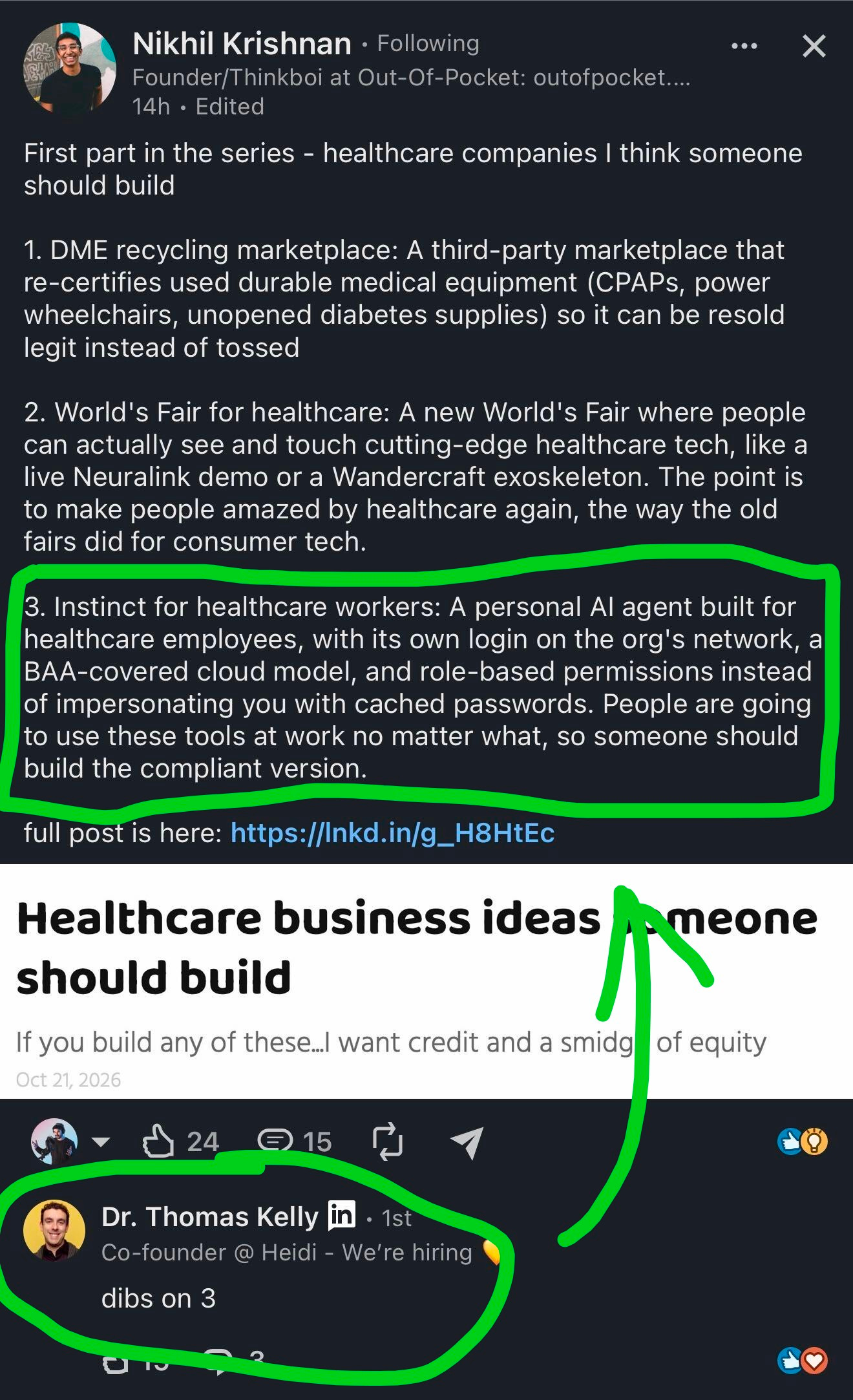
🤖 Suki raises $90m because being “just a scribe” no longer cuts it: You don’t see many Series Es in healthtech, so credit where it’s due. Suki, one of the US ambient scribe crowd, has raised $90m to build agents that handle the admin after the consultation.. the referrals, prior auths, orders and booking follow-ups etc. With the scribing itself now a commodity, value’s naturally moving to what the scribe plugs into and which processes it can take off a clinician from start to finish. And by thw way, they’re all at it. I spotted Heidi founder Dr Thomas Kelly calling “dibs” on Nikhil from Out of Pocket’s idea for a compliant personal AI agent for healthcare staff (see below). With mega rounds from Abridge ($300m) and Ambience ($243m), Suki CEO Punit Soni says “you should raise only how much you need,” which is a nice dig.
🚦 Scarlet raises $50M Series B to accelerate AI medical device certification: Founded by ex-Babylon pair James Dewar and Jamie Cox, Scarlet’s (the only?) one of the EU’s roughly 52 notified bodies that specialises in software and AI and they’ve raised a $50m Series B led by Headline (backers of Mistral). The customer list includes Flo, DeepHealth, Skin Analytics, NHS England, Heidi and Tandem, so a fair chunk of the most headline grabbing device certification has gone via them. I’ve had both James and Jamie on the podcast (latest one below) if you fancy hearing about what the near future looks like with AI, devices and regulation.
🇫🇷 Nvidia Buys a Slice of Doctolib (How Big a Slice? Non, Merci): Raising money is hard but a decent strategy is getting near Jensen Huang in a good mood and/or hope he sneezes and drops a few million. He rolled into Paris last week and rolled out having whacked a load of money into four French companies, Doctolib being the healthtech headliner. Nobody’s saying how much, and Nvidia doesn’t get a board seat (probably worth a few million itself). Doctolib says the money goes on hiring and building its own models (I’d lean on the latter in investor updates to Jensen). Those include a personal health assistant for patients and assistants for clinicians. That patient angle is the one I’m keeping a keen eye on…
🚑 Doctors Abandon AI as Their Shifts Wore On: This is a lesson in human factors and practicality when it comes to AI adoption. A Nature Medicine study put SHAKED (an LLM-based decision support tool) into one of two parallel units in a busy emergency department for four weeks. The AI was very accurate and supportive. BUT… clinicians stopped using it anyway. Within a single shift, usage fell from 68% to 30%. And length of patient stay was identical. Healthtech companies, listen up. ANYONE who’s done an A&E rota understands this scenario… you’re 3 months in, it’s hour 10 of 12 on your 4th night in a row and your whole body aches. What’s the likelihood you go over to a screen to check your decision making with an optional algorithm? Correct, extremely low. I’d actually argue that the best test in healthtech would be to give an optional device to someone on a 12-hour A&E shift and see if they’re still using it at the end. Also goes to show the value of interrogating the methods in a study. Measure adoption in the first hour? 68%. The last… 30%.
📸 AI Can Now Read Your Prognosis Off a Selfie (Almost): Clinicians, you know the gut feeling you can have about a patient, which isn’t related to any quantifiable metric. In a post-AI world, many believe we should be able to tun that into a metric. Enter the FAHR-Face model, trained on 40 million (!) faces and published in The Lancet Digital Health, estimates biological age and survival risk from a photo. If you look five years older than your birth certificate, your risk of death goes up 21%. In the highest-risk group, just over half died within 90 days (wow). Caveats? It was patients with cancer only, retrospective data and the signal held in 18 of 28 cancer types. A prospective trial in older lung cancer patients before radiotherapy is now under way, which is a good next step to see what’s actually working here, because my own gut feel is that this is useful. However (big however), whether patients want their prognosis read off their face is another conversation entirely. And imagine that algorithm finding its way into public CCTV…
🔬 Barts Health and Guy’s and St Thomas’ funding AI twins of human tissue: PharosAI is a collab between Barts Health, Guy’s and St Thomas’, Queen Mary and King’s, and it’s secured Innovate UK funding for DESTINY (honestly, these names…*). It tests whether AI can predict the expensive stuff (spatial transcriptomics, genomics, proteomics) from the data hospitals already collect. The long game is to apparently create “digital twins” of human tissue built with federated learning so the data never leaves the trusts. For now it’s a feasibility study, with up to £10m more available if it works. If it does, could be a very big deal for cancer care and drug discovery.
James’ editor notes:
* Since anyone can make these names up, I’m playing a game going forwards. For any… let’s say… un-robust studies, I’m calling it call it a PIGEON study (Predictive Intelligence Generating Exciting Outputs but N=1) 🐦

What to Listen to 🔊
Firstly, our own podcast, because if you like reading Healthtech Pigeon, you’d surely love to listen to us yap even more and watch our expressions whilst doing so (obviously once you’ve read to the end). This week we chatted Google’s Lancet study of its AMIE chatbot and wondered how it found its way into that publication, and whether women’s health data should sit behind a paywall. Spoiler, we don’t think it should, and a callout to the trackers to stop giving me pregnancy scares when my period is an hour late, thanks!
Have you ever sat down to start doing something important like writing in your journal, reading a book you enjoy or working on a project with a deadline, and then been sucked into the black hole of doomscrolling? Of course you have (not me when I’m working though James dw) and you feel awful whilst doing it but have no power to stop. This episode delves into the science behind regaining your attention currency within an online world that is begging for you to relinquish it.
Having lived with two medical students during my final year of uni, one thing I never heard the end of was how many logins and passwords they had to get through just to get anything done. This pod is the NHS’s own people explaining how referrals move today and where they get stuck. Not the sexiest listen, I’ll be frank, but since the Suki agent said it can do your referrals for you, this ep explains how difficult they actually are.
Events 📅
AI in Health Summit
🗓️ 4 Nov
📍 🇬🇧 Royal College of Physicians, London.
The Economist’s take on why AI keeps stalling between the pilot and the ward, with trust and accountability on the agenda. Good timing, given the government just pushed liability back to a working group. lol.
The ABHI UK HealthTech Conference
🗓️ 9–10 Nov
📍 🇬🇧 Cavendish Conference Centre, London.
If Scarlet’s raise got you wondering who decides what reaches patients, day one is basically that room (MHRA, AI and what happens to devices once they’re out there). Day two is all about getting the NHS to buy, so if you’ve ever had a trust love your product and then go quiet, it’s your day.
How will AI and AI scribes change health and care?
🗓️ 12 Nov
📍 🌐 Online
The King’s Fund is giving AI scribes a whole day, with NHS England’s national CCIO and the Patient Safety Commissioner on the bill. Everyone’s racing to own what happens after the note (hi Suki), but I’d quite like to know who’s checking the note was right in the first place. £90 + VAT, with free places for people with lived experience.
Visit the SomX events page or subscribe to SomX’s events roundup for everything else.
Opportunities 🕵️♀️
🚨 Frontline to Future, Cohort 2, Sanome. After this week’s 4am study, I’m glad someone’s asking the people on shift what they need before building the thing. Sanome makes early warning AI for patients getting worse in hospital, and wants resident doctors (FY2–ST2) and Band 6–8a nurses for about an hour a week from November, with evening slots that fit around rotas. It’s unpaid (you get a reference letter and a peer network), and sign-ups close Friday 6th November.
🩺 NHS Clinical Entrepreneur Programme, Cohort 11. If there’s an idea sitting in your Notes app from a night shift, this is your nudge. It’s a free year of mentoring and pitching for anyone working in the NHS, clinical or not (admin and managers very much included), and it’s built around keeping your day job. There’s no funding attached and your travel’s on you, but 691 start-ups have come out of it since 2016, so I’d take the odds. Applications close 4pm, 20th November.
📋 Clinical Specialist, Expert Roster, Scarlet (UK, Remote). Fresh off its $50m raise, Scarlet wants registered clinicians with a specialism to give a few hours of clinical input when it’s certifying a device, on a contract basis. If you’ve ever wondered who decides whether an AI tool is safe enough for your ward, it could be you. A decent side gig, and a proper excuse to read the evidence section.
🥐 Director of AI Developer Experience, Doctolib (Paris). Doctolib says the Nvidia money is going on hiring and building its own models, so here’s one of the hires. It’s a senior leadership role in Platform Engineering, all about how Doctolib’s own engineers build with AI. Bring a love of croissants (and maybe a few GPUs).
📣 Want something in front of our 8,000+ readers?
You can break your news as the main story, feature a podcast, job or event... and we even have a few sponsorship packages to choose from...
We review everything editorially - if it is not right for our audience, we’ll let you know - everything has to be valuable to this glorious community.
See you next week, Pigeon fans ✌🏼

Healthtech Pigeon is produced by SomX - the media-led communications and creative agency for healthcare. We help healthtech, biotech, pharma and public sector organisations tell sharper stories through strategy, PR, content, design, events and media production. Built by clinicians, scientists and creatives who know the space. Work with us.