




Hello healthtechers. Good news and bad news this week.
Big Tech has announced that its AI is better than doctors again (bad), but they’re also investing in real world things like brain implants for glioblastoma (good). And some cool events coming up, like Newton’s Tree’s online one on the 10th Nov on agentic AI in healthcare. Read on and enjoy.
James.
News Bites 🥪
🩺 Microsoft Says Its AI Beats Doctors on Hard Cases (Can We Please Stop Doing This?): I’ve said it before and I’ll keep saying it until everyone listens… in my humble opinion, pitting AI against doctors achieves nothing except making clinicians defensive. Mustafa Suleyman is calling it a step towards “medical superintelligence” after Microsoft’s diagnostic orchestrator, MAI-DxO, got 83% of complex New England Journal of Medicine cases right in a Science study, against 36% for generalist doctors working alone. Those “complex cases” are, of course, tidy written vignettes rather than the science and art of actually sourcing all the information from the physical world to create said vignette. Also leaves out the specialists and MDTs who actually handle hard cases, and GPT-5 on its own scored 78.9%, so am I missing something or is most of the magic in the underlying model? Show me how superintelligence helps us deal with corridor care this winter and I’m all ears.
🧠 OpenAI Backs a Brain Implant (the Useful Kind) to Fight Glioblastoma: When an AI giant puts money into a brain implant, I brace for something dystopian for my sanity. However, credit where it’s due… Coherence Neuro’s raised a $45M Series A co-led by the OpenAI Startup Fund. The plan is to treat brain cancer by ‘listening’ to it. Yea I didn’t get it either initially, but, essentially, a wireless implant reads electrical signals coming off the tumour, which guide electrical stimulation that adapts as the tumour grows and changes in the long gaps between scans. Glioblastomas are particularly difficult (almost impossible) to remove because they send tendrils deep into the brain, so monitoring and treating them continuously makes a lot of clinical sense. Early human testing’s started in Melbourne, with a chronic glioblastoma trial to follow soon. If you’re in any doubt about where big tech’s money should be going, for me… it looks a lot like this.
🚦 Finally, a Clinical AI That Admits When It’s Not Sure: This is interesting. It’s a clinical search engine that grades the evidence before it answers, colour-coding claims by strength and flagging anything flimsy in red. It’s a crowded space (OpenEvidence, etc.), but this actually tackles an issue that I encounter every day with my own LLM use (albeit non-clinical), when is looking at an output and wondering how much of it I can trust. This takes the binary nature out of that and allows for a spectrum of trust, which I think is a cool concept for clinicians getting comfortable with LLMs. I’m trying to sound like I’ve uncovered a gem here, but Vera says 800,000+ clinicians in 190 countries use it, so it’s not even close to new or original take that I’m presenting here. Interesting company too - only a team of 12! All company-reported numbers, though, so lets maybe grade the claims amber?
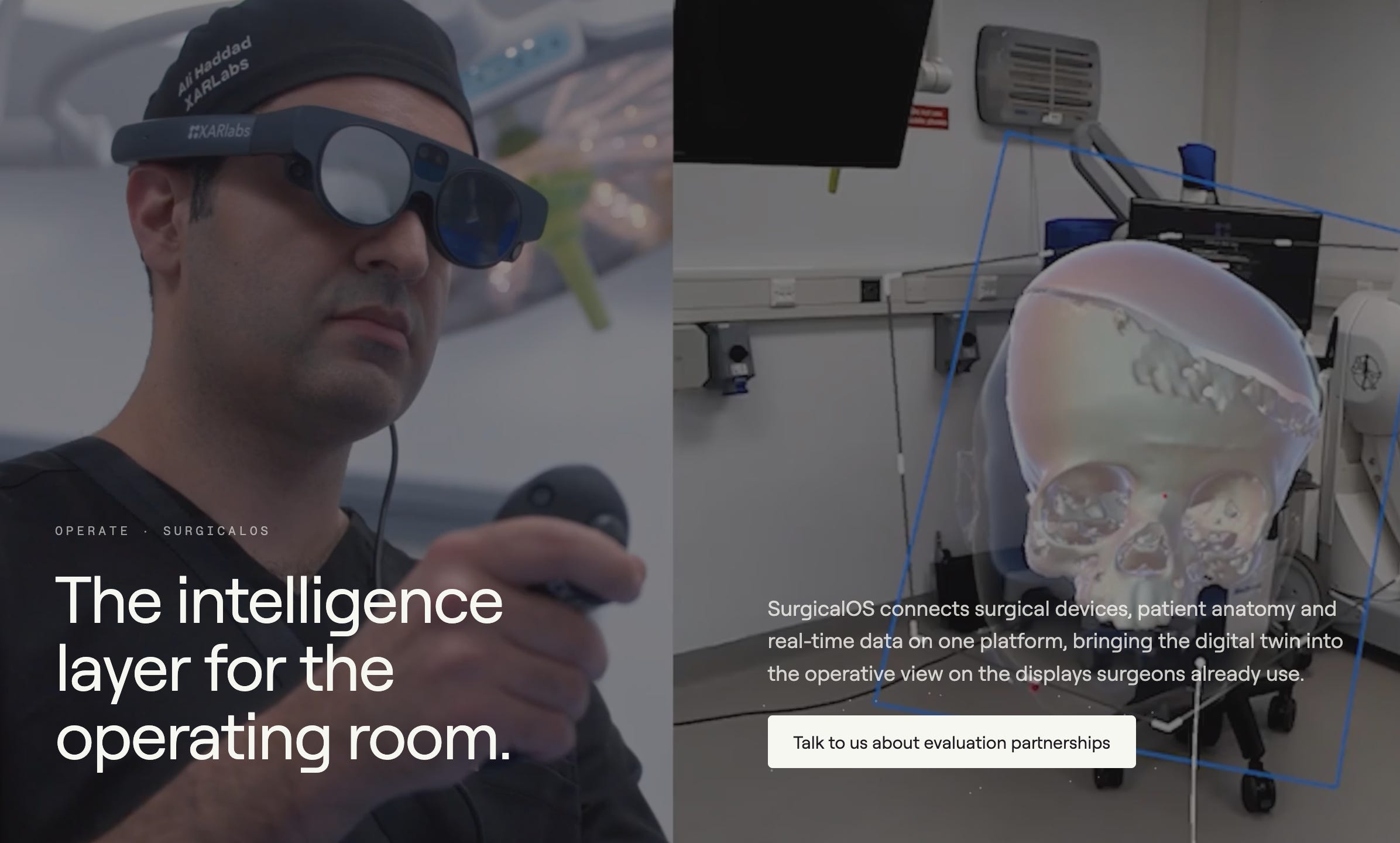
🔪 A UK Surgical AI Seed That Isn’t Small Change: This is the flashing segment and there’s an image below to put this whole thing into context. XRlabs has done a £6.3m seed for SurgicalOS, which does all sorts of VR-based ‘make-work-fun’ things for surgeons. I’ve seen a few things like this come and go in my time, so I think the business model here needs to be the real innovation. I don’t think you can argue with the fact that spinning an organ+tumour around in 3D space as an MDT ahead of surgery is a good idea to plan your approach. Or that more intelligence in any clinical area is a good idea. The trick will be proving ROI and the old who pays / who benefits equation. Looking forward to seeing how this one develops.
A few raises to show you direction of travel...
🧬 Ending the Diagnostic Odyssey (Probably): Here is AI solving an AI-style problem and a company called “Probably Genetic” that’s causing journalists a lot of sentence construction issues after raising a $12m Series A. I believe 7 years is the norm for a rare disease diagnosis, and in a world of LLMs, that isn’t tolerable at all.
🫁 Pulmonary Rehab Works. Getting It Is the Problem: Some have said that pulmonary rehab is one of the best-evidenced yet worst-delivered interventions, so Kivo Health has raised $10m Series A for a nine-week home programme pairing patients with those that can deliver it. Evidence here of care moving to the community, bypassing primary care.
💧 A Spit Test for Your Hormones?: Unravel Health has raised a £2.5m seed for a palm-sized device for at-home hormone readings from saliva. Yes, the concept sounds a bit… well… similar to a documentary out recently… and yes, saliva hormone testing does have a patchy record against good old-fashioned blood tests. But as Journey famously said… “Don't Stop Believin' [in point-of-care hardware].”**
And finally…
👂 Can you lower your blood pressure by zapping your ear? (Sort of, sometimes, maybe): This was funny to read. Researchers at Queen Mary University of London trialled a handheld device that clips onto the tragus and stimulates the autonomic nervous system through the skin. They tested it on 63 people with uncontrolled HTN (despite meds), and the headline (paraphrased) was “it’s safe, well tolerated, easy to use at home, would be great for this, but it doesn’t work.” Made the news because of a subgroup with severe hypertension did get a BP reduction, but for OGs that read every week and get this far down the newsletter, this one’s a bit of a PIGEON study, methinks…***

What to Listen to 🔊
Half my FYP is people (well, influencers) hooked up to NAD drips at 9am, so I was always going to press play on this one. James sits down with Dr Prarthana Venkatesh, a London-trained surgeon turned McKinsey consultant turned founder of Longevita. They get into peptides people are taking way ahead of the human trial data, why she cut the doses in her own 12-ingredient formula, and whether you can actually overdo NAD. Pair it with our spit test story above, and you’ll never look at a wellness shelf the same way again.
It makes me giggle that ONLY I know what the vagus nerve is from seeing looksmaxxers on social media claim to have supreme control over it. But now my horizons are growing because a professor of cerebrovascular neurology has been summoned to debunk the myths surrounding the body’s longest cranial nerve; it’s quite something. It runs from the brainstem down to the heart and gut, and one of its branches reaches the outer ear, which interestingly connects to our blood pressure story above. I should probably send this one to Clavicular.
If you're a woman, you've probably wrestled with the look of stretch marks more than once, but Helen O’Neill (co-founder and CEO of Hertility) and host Sinead O’Moore argue they go beyond a physical manifestation and happen throughout your life. O’Neill highlights the importance of talking about how women’s health concerns are often dismissed or ignored, and how Hertility is taking access to the next level through at-home testing kits. But does that mean only those who can afford it get to reap these benefits?
My surgeon friends often battle with the enormity of holding someone’s life in your hands, and this ep of Behind the Knife tackles that head on, particularly the emotional toll of when a surgery goes wrong. If you’re a clinician (first of all, thank you) and have struggled with this weight on your shoulders, consider this your sign to try and let go of the idea that a good surgeon has to be perfect.
Events 📅
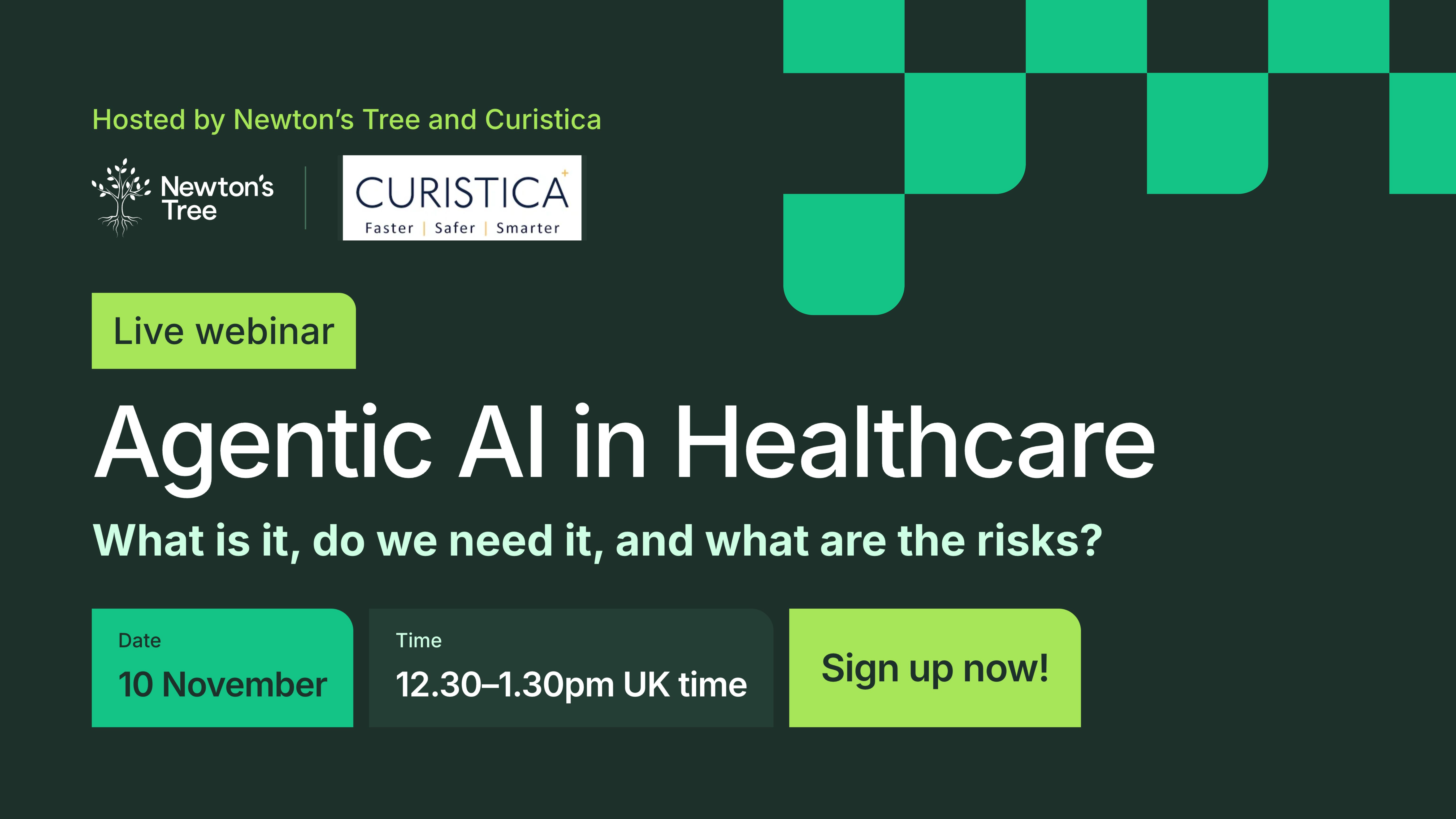
🤖 Agentic AI in Healthcare: What Is It, Do We Need It, and What Are the Risks?
📅 Tuesday 10th November, 12:30–13:30
💻 Online
AI that drafts a discharge summary is one thing. AI that reads your patient safety incidents and emails people without anyone checking each step is quite another. Newton’s Tree and Curistica have put together a superb panel to work through the questions every trust will soon be asking… who’s responsible when an AI agent gets it wrong, what happens when governance is weak, and which controls actually reduce the risk? Dr Haris Shuaib (Newton’s Tree) chairs, with Duncan Dewhurst (Buckinghamshire NHS Trust), Keith Grimes and Youssof Oskrochi (both Curistica), and there’s a live Q&A at the end. If you’re a CIO, a digital lead or anyone considering bringing “agentic AI” to their organisation, this is a lunchtime well spent. If you’d rather debate it in person, there’s also an evening event in central London on 26th November, with drinks. Click on the link below for more info. Featured by SomX.
AI in Health Summit
🗓️ 4th Nov
📍 🇬🇧 Royal College of Physicians, London.
The Economist’s take on why AI keeps stalling between the pilot and the ward, with trust and accountability on the agenda. Good timing, given the government just pushed liability back to a working group. lol.
The ABHI UK HealthTech Conference
🗓️ 9–10th Nov
📍 🇬🇧 Cavendish Conference Centre, London.
If XRlabs’ raise got you wondering how a surgical AI actually gets cleared for patients, day one is basically that room (MHRA, AI and what happens to devices once they’re out there). Day two is all about getting the NHS to buy, so if you’ve ever had a trust love your product and then go quiet, it’s your time to shine.
Genomics and Precision Medicine Congress
🗓️ 10th Nov
📍 🇬🇧 BMA House, London.
Rare disease patients waiting years for an answer is exactly why Probably Genetic exists, and this is where the NHS’s genomics crowd work out how to get testing into everyday care. Sir Mark Caulfield is on a panel about pharmacogenomics (how your genes decide which drugs actually work on you), which I’d quite like explained to me in person.
Visit the SomX events page or subscribe to SomX’s events roundup for everything else.
Opportunities 🕵️♀️
🔬 Head of AI Research, XRlabs (London). I had no idea 10% of operating time goes on adjusting the scope by hand (their stat, not mine), and XRlabs has just raised £6.3m for software that gets every gadget in theatre talking to each other. You’d lead the research behind it, and they’re also hiring a Senior AI Research Scientist and a Head of Platform Software if you’d rather build than lead. The year’s top award is a trip to the Palo Alto office, which is the best staff perk I’ve seen in a while (James, are we expanding anytime soon?)
⚡ IT Engineer, Coherence Neuro (Cambridge). Of all the jobs at an OpenAI-backed brain tumour implant company, this is probably the least sci-fi, and I mean that nicely (obvs). You’d own IT and security at a medical device company working to ISO 13485, which matters quite a lot when the data is someone’s brain activity. One of their company values is ‘keep the laughter’, so hopefully someone giggles when you ask them to turn it off and on again.
🚦 Ex-Founder, Vera Health (San Francisco). Possibly the most honest job title in healthtech. Fresh off its $28.5m Series A, Vera wants people who’ve built a company before (however it ended) to find its most urgent problems and own them. It’s also hiring remote Regional Clinical Directors for Italy and Spain, so the UK is still waiting its turn.
James’ editor notes
* I think there are two frontiers in healthtech worth caring about. The technological frontier is how far we can push what’s possible, i.e. new sensors, LLMs, quantum, superintelligence, whatever comes next. The adoption frontier is what can actually be used in a hospital on Monday, and it’s held back by old infrastructure, bleeps, fax machines, information governance, regulation, procurement and the cost of all of the above. Nearly all the money and talent piles into the first one, while the second one seems to fall further behind every year. The irony is that the best tool we’ve ever had for closing that gap is the very technology being used here to score points off GPs. Maybe big tech doesn’t see adoption as its job, and fair enough. Just please drop the doctors-versus-machines framing, because it’ll be doctors with machines that get this done, and the clinicians aren’t going anywhere. (To be fair, Microsoft is now testing DxO alongside consenting patients at Beth Israel Deaconess in Boston. They should lead with that).
** It’s been a while since a joke as bad as this has made it into Pigeon.
*** See last week’s edition for the definition of a PIGEON study.
📣 Want something in front of our 8,000+ readers?
You can break your news as the main story, feature a podcast, job or event... and we even have a few sponsorship packages to choose from...
We review everything editorially - if it is not right for our audience, we’ll let you know - everything has to be valuable to this glorious community.
See you next week, Pigeon fans ✌🏼

Healthtech Pigeon is produced by SomX - the media-led communications and creative agency for healthcare. We help healthtech, biotech, pharma and public sector organisations tell sharper stories through strategy, PR, content, design, events and media production. Built by clinicians, scientists and creatives who know the space. Work with us.