




Hello healthtechnophiles…
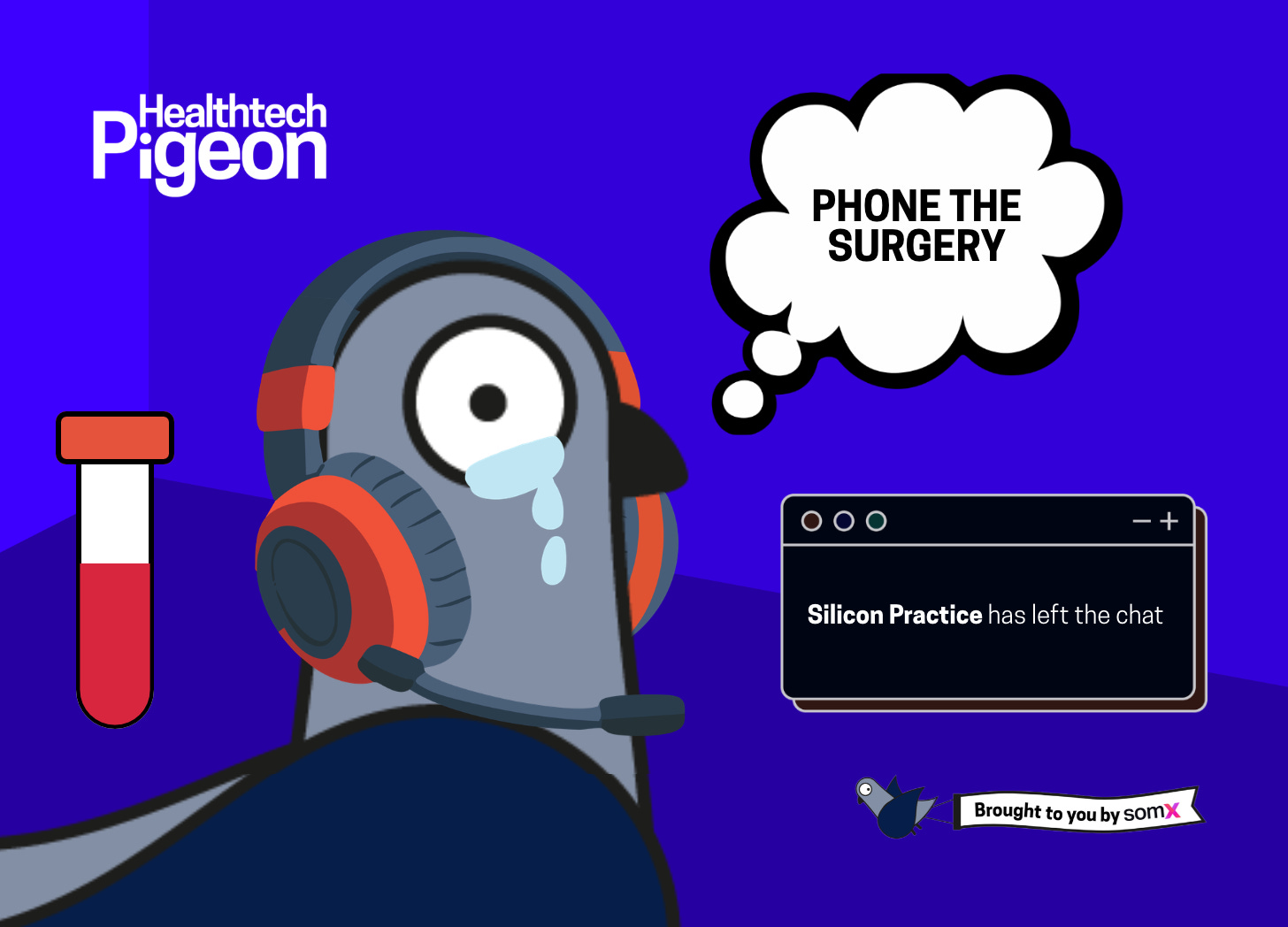
It’s been a week of things falling over. Heidi cofounders, a GP website supplier, my wifi. Meanwhile, the outrageous image below reached an actual online news outlet (looks like something out of Hitman) and good news if you’re into SomX events, we’re doing an online one (details below).
Also, now that Anna does the podcasts section, I have to flog my own up here now, so if you’re early stage (anywhere between idea and product-market fit), or you’re interested in care for older adults, this week’s with Julia is a good one to listen to 👇🏼
Enjoy,
James
News Bites 🥪
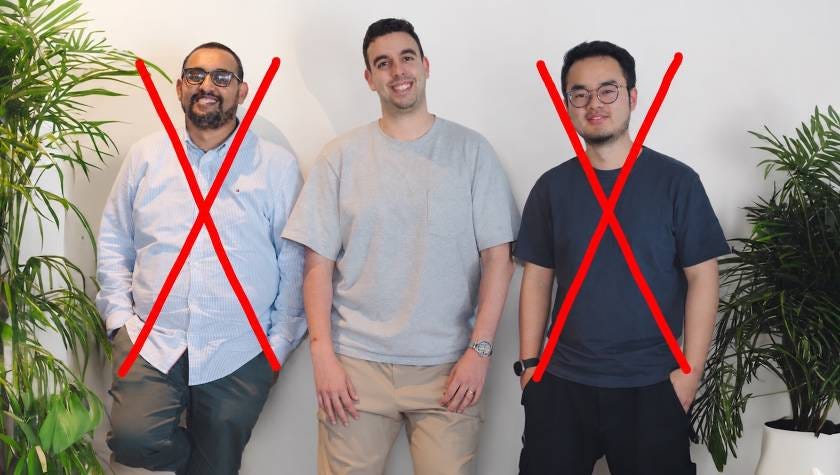
🩺 Heidi’s had a week: Two months after becoming a unicorn, Heidi lost 2/3 cofounders. Yu is reportedly off to build robots, and Waleed’s leaving for family reasons. The next day, Heidi dropped the big ‘R’… 18% of the 600+ staff went. Tom (middle guy, no red X, CEO) says they were “too optimistic” about how fast big health systems buy, so they’d built up enterprise teams to wait on hospital deals that move at hospital speed, hence lay-offs. Sounds about right. And look, cofounders grow businesses and leave all the time (with lots of equity, ability to borrow against it and a future payday all intact by the way… and all their time back… to see the family they’ve at least in-part sacrificed). There was also that thing about Best Practice telling GPs that running Heidi II’s agents breaches their licence recently too, so they’ve got everything off their chest at once, which is cleansing and lets the next company’s crisis take over the news cycle next week. For what it’s worth, Tom’s one of the more open, communicative CEOs in the sector and in my humble opinion, his messages online during all this have been tasteful and authentic.
💻 The GP Front Door Just Fell Off Its Hinges: This was a weird one. It’s more a story out of the 90’s, but Silicon Practice that provided GP websites went into administration. About 10% of England’s practices were affected (GP Online reckons about 600 total), mostly in Gloucestershire, London and parts of Wales. In lieu of a website, patients are being told to just phone or pop in. Oh the irony. Where’s the patient data gone? What happened to the requests sitting in Friday afternoon’s queue? 🤷🏻♂️
💊 Woman dies of seizure after ChatGPT misguidance. Parents sue OpenAI: Bowen Wan was a 31-year-old software engineer in Seattle with epilepsy. Her family is suing OpenAI and Sam Altman, alleging that GPT-4o coached her off her anti-seizure medication. According to the suit, she went from her usual lamotrigine dose to nothing over about 25 days on a schedule built with the chatbot. She raised concerns at least 158 times and was repeatedly told her symptoms were part of recovery. She died of SUDEP (sudden death of someone with epiepsy) on the 12th February, and GPT-4o left the consumer app the next day. None of this has been tested in court. OpenAI says the model is gone and its newer ones are better at spotting when something is urgent.
🩸 A blood test for 13 cancers is coming to your GP: STRIDE-RCT, led by the University of Birmingham with up to £8.5m of Office for Life Sciences money via NIHR, is going to offer multi-cancer blood tests to >20,000 patients across 200 practices, looking for 13 cancers from bowel to bile duct and measuring the tests against good old GP judgement. But, unlike similar, failed trials of the past, for this one you need symptoms like bloating. It’s a randomised platform trial, so several tests can go head to head, but what we don’t want is falsely reassured GPs and patients, so that’s the thing to look out for here. The trial runs to 2031, so don’t expect it soon, but do expect it to seriously up the NHS’ prevention game if all goes well…
🍽️ Eating disorders are up 71% since 1990, and GLP-1s could be making things worse: A new JAMA Psychiatry study covering 204 countries found anorexia and bulimia rose 71% between 1990 and 2023. That’s 18.1 million people living with one of the two now, 21.8 million by 2050. Now, think about GLP-1s in that context… They might calm the urge to binge in bulimia, but in anorexia, hunger goes quiet, eating gets unpleasant, it makes the anorexic state more comfortable. For a condition with one of the highest mortality rates in psychiatry, that’s not a side effect you want to hand out by accident, but most UK GLP-1 prescribing now happens privately and online, so the responsibility sits with those providers, and many argue that their commercial incentives don’t exactly favour a tougher front door.
🫀 adsilico raises £10M to test medical devices on virtual patients: It’s odd to think that with compute and simulation where it is, that clinical trials still come down to a small number of human participants (and you can guess what the demographic’s been historically), hence diversity and accuracy across populations have always suffered. adsilico are combatting that directly with Virtual Chimera, i.e. building virtual hearts and vessels from anonymised scans and running physics-based simulations of hardware devices inside those hearts across patients of different ages, sexes, ethnicities, body sizes and conditions, before anyone gets one in reality. They’ve raised a £10m Series A and glad to say it’s one we’re fortunate to now work with at SomX. In silico won’t replace trials. But finding the answers to sizing problems in a simulation is much better than needing to do it in people (and fewer animals too, which the animals will appreciate).
And finally… 🧬 Anthropic buys a small but mighty biotech: Specifically, Mithril Medicine, which is a preclinical muscular dystrophy biotech with, as far as anyone can tell, a headcount of one. The founder, a guy called Cody Tranbarger, now joins Anthropic to carry on the work and start new programmes. Price undisclosed which is annoying because everyone loves to know. Anyway, Anthropic owning a drug programme rather than selling models to pharma is interesting…

What to Listen to 🔊
If you’ve ever been served an ad for a blood test that claims to find more than 50 cancers, this one’s for you. Toronto oncologist Dr Raymond Kim explains what these liquid biopsies can actually do so far, and why he’d think twice before paying for one. It’s the perfect partner to the STRIDE trial above, which is finally asking the question properly (with symptomatic patients and a control group).
Spoiler, I am going to go with a big fat yes. This episode looks at the chatbot from the other side. It’s about the loop so many of us know (feel a twinge, ask ChatGPT, feel fine for ten minutes, come back with a new twinge) and why reassurance on tap can make health anxiety worse. My generation went from Dr Google to Dr GPT without blinking, so 13 minutes on why the answer never quite settles you is a lunch break well spent.
Virtual patients sound very 2026, but people have been building computer models of the body for decades, and Professor Marco Viceconti was there for most of it. He set up the Insigneo Institute at the University of Sheffield (a bit of Yorkshire pride, with adsilico being a Leeds spinout, big up to my uni) and helped found the VPH Society, the in silico medicine crowd behind this podcast. The second half is the bit to stay for, when he gets into why so many clever models never make it into a hospital.
Events 📅

The hidden economics of growing healthcare businesses (Online)
📅 Wednesday 2nd December, 14:00-15:00
🌐 Online
Whether you’re building a healthcare business, backing one or advising one, there’s a question that comes up sooner or later… why does growth leave margins looking worse? Simplifying can strip out the revenue, so what do you do? We’re hosting this one with Cority Meddbase. You’ll hear from a founder who’s scaled a provider, an M&A adviser who values health businesses and the Meddbase team. They’ll cover where complexity pays, where systems eat profit and what investors look for at valuation. Useful for anyone interested in the business of healthcare. Essential for owners, operators, investors and advisers in private healthcare. Request your place early, as it’s approval-only.
🏘️ (Is) Neighbourhood Working? An evening with Dr Claire Fuller
📅 Thursday 26th November, 18:30–20:30
📍 🇬🇧 London (announced after you register)
If you want to understand where primary care is heading, this is the one. Dr Claire Fuller wrote the blueprint that put integrated neighbourhood teams at the heart of NHS policy, and she now leads Neighbourhood Care nationally. She’s joining Anima’s Dr Ben Walker for an honest fireside on what’s working, what isn’t yet, and what comes next. After, there’s a Q&A, with food and drinks to follow. Places are limited and approval-only, so get your request in now.
Genomics and Precision Medicine Congress
🗓️ 10th Nov
📍 🇬🇧 BMA House, London.
After STRIDE, I’d love to know how many people in this room think a blood test will be finding cancer in GP surgeries within the decade. This is where the NHS’s genomics crowd work out how to get testing into everyday care. Sir Mark Caulfield is on a panel about pharmacogenomics (how your genes decide which drugs actually work on you), which I’d quite like explained to me in person.
London Life Sciences Week
🗓️ 15–20th Nov
📍 🇬🇧 Venues across central London.
A whole week of life sciences, with 100+ events and (apparently) 1,300+ investors milling around London. If an AI lab buying a one-person biotech has you wondering where the money goes next, this is the week to find out over a lanyard and a lukewarm coffee. Pick a few from the programme and pace yourself (trust me, ex-HLTH events girl here).
Visit the SomX events page or subscribe to SomX’s events roundup for everything else.
Opportunities 🕵️♀️
🚨 NHS Cancer Programme Innovation Open Call 4. If STRIDE has you thinking about what else could get cancer found sooner, NHS England has money on the table. Market-ready innovations can bid for up to £3m to be rolled out and independently evaluated across NHS sites in England (you’ll need an NHS partner and an evaluation partner lined up). ICBs and Cancer Alliances can go for up to £5m to spread something that’s already proven.
📞 Business Development Manager, X-on Health (UK, Remote). Remember X-on circling after Silicon Practice went under? Here’s the person who’ll be doing the circling. X-on makes Surgery Connect (the cloud phone system a lot of GP practices use) and wants someone to demo its kit to practices, AI tools included. The pay is £35k plus uncapped commission (they reckon £70k is realistic) and a car allowance. There’s lots of travel, so you’ll need a full UK driving licence. Practices are suddenly very keen on suppliers that still answer the phone, so the timing’s not bad.
🧬 Applied AI Engineer, Beneficial Deployments (Rare and Neglected Diseases), Anthropic (London). While it’s busy buying a muscular dystrophy biotech, Anthropic also wants someone in London to help nonprofits and research institutes run better trials for rare diseases that nobody’s paying to treat. Much of the job is drug repurposing (finding new uses for old, cheap medicines that are already known to be safe), which might be the least hypey use of AI I’ve read about all year. You’ll need hands-on clinical trial experience and the ability to ship production code. The salary is an eyewatering £225k–£255k, so yes, I read the spec twice.
📣 Want something in front of our 8,000+ readers?
You can break your news as the main story, feature a podcast, job or event... and we even have a few sponsorship packages to choose from...
We review everything editorially - if it is not right for our audience, we’ll let you know - everything has to be valuable to this glorious community.
See you next week, Pigeon fans ✌🏼

Healthtech Pigeon is produced by SomX - the media-led communications and creative agency for healthcare. We help healthtech, biotech, pharma and public sector organisations tell sharper stories through strategy, PR, content, design, events and media production. Built by clinicians, scientists and creatives who know the space. Work with us.