




Hey healthtech fans.
This one’s coming to you a bit early - I’m on holiday this week so have some serious relaxing to do this afternoon. A quick announcement before we begin…

If you’re in Manchester on 25th November evening, Neko Health are offering a tour of their new clinic and a private drinks reception with the Neko C-suite for just 20 people. Healthcare and policy leaders take priority, but all are welcome to apply.
Get in quickly (today, ideally). These will go, fast. ✅
And in a news week dominated by big tech:
the NVIDIA CEO memes are completely out of control
Microsoft reminded us all what healthcare could look like if any of the US tech/AI companies we’re dependent on switch off
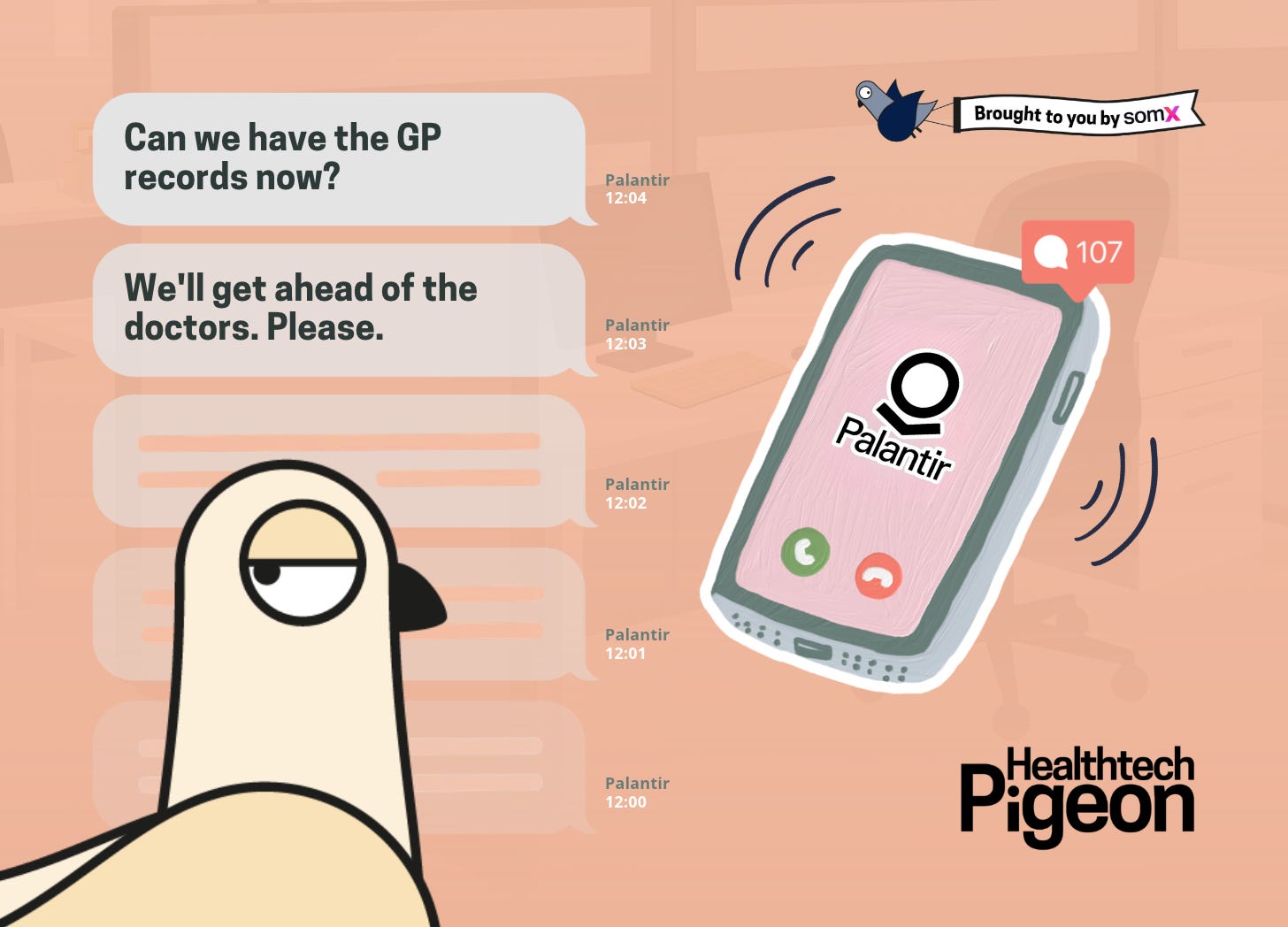
Palantir does a Palantir
some cool events to sign up to so make sure you get to the bottom
… and more
With all the talk of sovereign AI and Microsoft going down, have a listen to this for a deep dive…
Enjoy.
James
News Bites 🥪
🖥️ Microsoft Went Down & The NHS Went With It: This should be a massive warning to everyone about just how reliant we are on a few big companies. It’s what I spoke to Jack about on the podcast (see link above) in the context of Sovereign AI. Unless you’re under a rock, you’ll know a failed server health check knocked out Outlook, Teams and Copilot across >70 countries the other day. The NHS was reportedly the hardest-hit health system in Europe as we run the entire workforce on Microsoft. GP surgeries and pharmacies lost online booking and contact tools, trusts warned of slower responses, in Australia, some sites went back to paper prescriptions. This is a petrifying definition of “single point of failure.” Also, while we’re at it with big tech… of all the departments for NVIDIA CEO Jenson to allegedly get into bed with… the VP of healthcare?? Come on man, give us a break in this sector, we need some good news.

🔐 Palantir Wanted Your GP Records. It Asked a Minister on WhatsApp: Remember when the government promised GP data wouldn’t be part of the national platform? Palantir does. And it doesn’t seem keen. WhatsApp messages released under FOI show Palantir UK boss Louis Mosley pushing then health minister Zubir Ahmed in February to bring GP records into the Federated Data Platform. He said the logic of joining up primary and secondary care data was “unarguable” (kind of fair) and that ministers would need to “get ahead of” opposition from doctors (also fair, but lolz at the “please sort” tone). To be absolutely clear, GP data definitely sits outside Palantir’s £330m NHS England contract. The BMA warns of scope creep and DHSC declined to comment 🤷🏻♂️
💍 Oura Just Spent $625m Putting a Doctor in Your Ring: Another sign that wearable companies are becoming entire healthcare systems. Oura’s buying Counsel Health, an AI-native primary care company, for $625m. Essentially, you chat to Counsel’s AI, which reads your records, guidelines and biometric data, and at any point you can bring in a doctor who can diagnose, prescribe and refer. The thing is… and I have to be careful with language not to activate some highly paid lawyers here… but to the best of my knowledge, Oura still says the ring isn’t a medical device. However, it now sits one tap away from a doctor who can write you a prescription. Now, I’m not saying the doctor is influenced by the signals from the wearables when writing the prescriptions because that would surely make it a medical device? But would you say that’s never happened? Isn’t that the point here? Are we not skirting around the idea that wearable data helps infer correct diagnosis? 🤷🏻♂️
💊 NHS Patients Could Get New Drugs in Six Months. But there’s a catch: Right now, a promising new drug gets assessed by NICE before patients can have it, and again after the real-world evidence comes in. The new SMART pilot (Streamlined Managed Access Route for Therapies - of course it is) wants to shorten the first step from about a year to 6 months. They’re careful to say 6 months is a target rather than promising anything, and that “speeding up access does not mean lowering standards.” Fair enough. But can NICE say no to a drug patients are already taking? Anyone who lived through the Cancer Drugs Fund years knows how painful that can get.
🔗 Google Partners with ‘Patients Know Best’ For Your GP Record: Huge fan of PKB and their founder Mohammad, who I had on the podcast a while ago, so this is interesting… users in England can now sync their NHS records from GP practices and a growing number of hospitals, via PKB. That means your GP letters sitting next to your sleep score and glucose graph, in an app with an AI coach. Brilliant for the patient who wants one place for everything and puts the pressure on the NHS app to provide utility. What will GPs say when you bring the Google Health AI coach’s interpretation to your next appointment? Are we looking at the future?
🗣️ The MHRA and NICE Agree to Stop Asking Patients the Same Thing Twice: The MHRA has published its Patient and Public Involvement and Engagement Plan for 2026 to 2030. Ironically a far-from-engaging name and inexplicably not abbreviated to The PAPIE Plan, but it does important work to be aware of in healthtech. It’s building communities to shape how benefits and risks are weighed, involve patients in clearer medicines information, and work with NICE so companies stop submitting the same patient involvement evidence twice. Their last review said patients felt they didn’t hear what happened to their input, so better feedback is the order of the day. Judge it on whether patients notice the difference.
And finally…
🌍 Who Decided What “Healthy” Means in Your App? The Lancet Has Questions: Interesting read from The Lancet Digital Health, which argues that most health tech is built on a white, Western idea of the patient (don’t know who would argue against that). The authors turn it into a practical checklist of justice questions for each stage of the learning health system loop, where bias compounds.

What to Listen to 🔊
Oura says it isn’t a jewellery company, and after this week I’m inclined to believe it. In this chat from June (before the IPO got shelved), CEO Tom Hale tells Imran Amed that women’s health flipped Oura’s customer base to mostly female, and that 11% of wearers are medical professionals. He also says (everyone’s already got a supercomputer … on their body), which reads a bit differently now that his company owns a doctor too.
If the WhatsApps left you wondering how Palantir ended up with NHS data in the first place, this is your catch-up. Investigative journalist Lucas Amin explains how the company won its £330m contract and what happened once the software was rolled out. It comes from the same Guardian that broke this week’s messages (so expect a raised eyebrow or two).
Events 📅

The hidden economics of growing healthcare businesses (Online)
📅 Wednesday 2nd December, 14:00-15:00
🌐 Online
Whether you’re building a healthcare business, backing one or advising one, there’s a question that comes up sooner or later… why does growth leave margins looking worse? Simplifying can strip out the revenue, so what do you do? We’re hosting this one with Cority Meddbase. You’ll hear from a founder who’s scaled a provider, an M&A adviser who values health businesses and the Meddbase team. They’ll cover where complexity pays, where systems eat profit and what investors look for at valuation. Useful for anyone interested in the business of healthcare. Essential for owners, operators, investors and advisers in private healthcare. Request your place early, as it’s approval-only.
🏘️ (Is) Neighbourhood Working? An evening with Dr Claire Fuller
📅 Thursday 26th November, 18:30–20:30
📍 🇬🇧 London (announced after you register)
If you want to understand where primary care is heading, this is the one. Dr Claire Fuller wrote the blueprint that put integrated neighbourhood teams at the heart of NHS policy, and she now leads Neighbourhood Care nationally. She’s joining Anima’s Dr Ben Walker for an honest fireside on what’s working, what isn’t yet, and what comes next. After, there’s a Q&A, with food and drinks to follow. Places are limited and by approval only, so submit your request now.
🤖 Newton’s Tree Presents: Agentic AI in Healthcare
📅 Thursday 26th November, 16:00–20:00
📍 🇬🇧 Hale House, Portland Place, London
A chatbot answers your question. An agent goes off and actually does something, inside the systems a hospital runs on. Newton’s Tree want to dissect this gap in person, after its lunchtime webinar earlier this month. There’s a keynote, a real story of agentic AI already working in the NHS, and an interactive expert panel, then drinks and networking. It’s aimed at healthcare leaders weighing up whether to let an agent loose in their organisation.
London Life Sciences Week
🗓️ 15–20th Nov
📍 🇬🇧 Venues across central London.
A whole week of life sciences, with 100+ events and (apparently) 1,300+ investors milling around London. If an AI lab buying a one-person biotech has you wondering where the money goes next, this is the week to find out over a lanyard and a lukewarm coffee. Pick a few from the programme and pace yourself (trust me, ex-HLTH events girl here).
Visit the SomX events page or subscribe to SomX’s events roundup for everything else.
Opportunities 🕵️♀️
🐂 Epidemiologist / Health Data Scientist, Bennett Institute (Oxford). The Bennett Institute’s platform runs analysis across the health records of 55 million patients, and researchers’ code goes to the data instead of the data going anywhere. You’d work on research like vaccine safety and trends in medicines use, and help outside researchers use the platform.
🌸 Director, Head of Global PR & Communications, Flo Health (London). Calling all my fellow comms peoples with a few years under their belt. Flo is the world’s top health and fitness app (80M+ monthly users, 7M paying), and it wants someone to run its PR worldwide, from product launches to talking journalists through the research.
🕵️ Forward Deployed Software Engineer, New Grad - UK Government, Palantir (London). If you’d rather be on the inside of the WhatsApp group, Palantir is hiring graduates to embed with UK government customers. Expect 25–50% travel and a security clearance, and you need to graduate by 2027.
🗣️ Opportunities for patients and the public to be involved in the work of the MHRA. If the MHRA’s new plan is going to mean anything, it needs actual patients in the room. The Community is open to patients, carers and patient organisations who want a say in how medicines and devices are regulated, through meetings, surveys and feedback on drafts. The catch is that anyone working in healthcare, public health or the medicines and devices industry can’t apply, which rules out most of you reading this. Forward it to your mum or the patient group you keep meaning to support.
📣 Want something in front of our 8,000+ readers?
You can break your news as the main story, feature a podcast, job or event... and we even have a few sponsorship packages to choose from...
We review everything editorially - if it is not right for our audience, we’ll let you know - everything has to be valuable to this glorious community.
See you next week, Pigeon fans ✌🏼

Healthtech Pigeon is produced by SomX - the media-led communications and creative agency for healthcare. We help healthtech, biotech, pharma and public sector organisations tell sharper stories through strategy, PR, content, design, events and media production. Built by clinicians, scientists and creatives who know the space. Work with us.