



If you’ve been on Instagram recently and had the misfortune of clicking anything to do with GLP-1s, the algorithm now thinks you want one… and along with the companies selling them, that dynamic (dystopian) duo will stop at NOTHING until you get one.
People in my other world (comms/marketing/media) will know about the Advertising Standards Agency (ASA for short) and it’s meant to regulate all advertising, which is a “boil the ocean” type of remit in 2026. They ask influencers to put #ad on their posts, they ask for things to be removed if they’re in breach. I wouldn’t say it’s toothless, but it’s not feared.
Between that, humans’ innate drive to live forever, look good doing it, and the financial prizes at stake for companies, B2C (and to be honest, more B2B that you’d expect) healthcare marketing is an absolute sh*t show. If you recap the seven deadly sins and think about a campaign for a health product, it’s likely to be playing on a full house.
For more context on the issue here, in April, the ASA claimed a very odd victory, i.e. that they’d monitored 44 advertisers selling weight-loss treatments, identified around 900 ads likely to breach the rules across 38 of them, “taken enforcement action,” and “driven compliance" among monitored paid-for ads up to roughly 99%.
In theory, ok they’ve done their job, but the gate was clearly shut after the horse had bolted and it makes you wonder how many people that horse had run over before being recaptured. Further down the same report was a really big issue… non-paid content (especially influencer and affiliate advertising) presents a higher risk of non-compliance. A new, very dark grey area.
I’ve been thinking about this since I had Deborah Cohen on The Healthtech Podcast. She’s fantastic. A medically qualified investigative journalist, built the investigations unit at the BMJ, was science editor at ITV News, health correspondent at Newsnight, and has just published Bad Influence: How the Internet Hijacked Our Health, which has now been shortlisted for the Royal Society Science Book of the Year.
We chatted about what this all means for clinicians, patients, healthtech companies… and it’s so important to understand if you’re building (or simply consuming) in this space.
The rules stop in a very specific place.
Deb has been regulated in her day jobs. As a broadcaster she answered to Ofcom on accuracy and fairness, and to defamation law if she gets a person wrong. But…
“YouTube’s not within that code, podcasts aren’t within that code.”
She’s right, and I even joke with guests on my podcast that “this isn’t regulated, you can say what you like.” My intent’s to reduce anxiety and have a laugh occasionally… but others’ intent is, frankly, to exploit the rules and instil fear to sell drugs.
Interestingly, the Media Act 2024 extends to something pretty close to Broadcasting Code standards for designated ‘Tier 1’ video-on-demand services, things like Netflix, Prime Video, Disney+, ITVX, Channel 4 On Demand etc.. But it obviously doesn’t touch the platforms like YouTube where most people actually encounter health content (ironically a mere click away on the same smart TV). And podcasts are absent from the Act entirely, which was a gap flagged in a parliamentary research briefing at the time.
Before researching this, I also didn’t know that Canada has brought podcasts into scope under its Online Streaming Act in 2023. So not only is it possible, but there’s precedent.
Deb likened the reactionary ASA activity to the (equal parts fun and infuriating) game of whack-a-mole and talked about a prescription-only migraine drug appearing in her own Instagram feed, promoted by Khloé Kardashian. She put it to Meta, who, predictably, declined to engage, and to Google, who said no rules had been broken.
The ASA’s position was that if the ad was intended for a US audience, the UK code may not apply. But it wasn’t obviously intended for a US audience. It used an American brand name, which, if you search it, returns UK pharmacies willing to prescribe it. Infuriating.
If you’re running a healthtech company, you should know this, but I’ll recap anyway… just in case. Britain bans direct-to-consumer advertising of prescription medicines. In fact, most of the world does. But, it’s one of those bans that’s now really leaky in a world that’s moved on since it was written. It used to be that people bought literal ad space. Now the definition of ‘advertising’ is convoluted and exploitable.
So this is the escalation…
Paid ads are monitored and now largely compliant ✅
Influencer content is harder to catch ⚠️
Affiliate content is harder still ❌
In February, the ASA reached the bottom rung and ruled against ordinary members of the public who had posted about weight-loss injections using referral links and discount codes, on behalf of all the big online pharmacy names. The ASA’s investigations manager said affiliate marketing is not a loophole. A good catch.
Then I saw an Instagram ad, aimed at employers, arguing that if your staff take GLP-1s they will take less time off and your bottom line will improve. I can’t find it now - hopefully’s it’s gone forever from the internet, but it did make me wonder how on earth we got here, how we stop these floodgates, and even what is my role in all this at the intersection of healthcare and media?
While I can’t find that one, ads like these are all over the place 👇
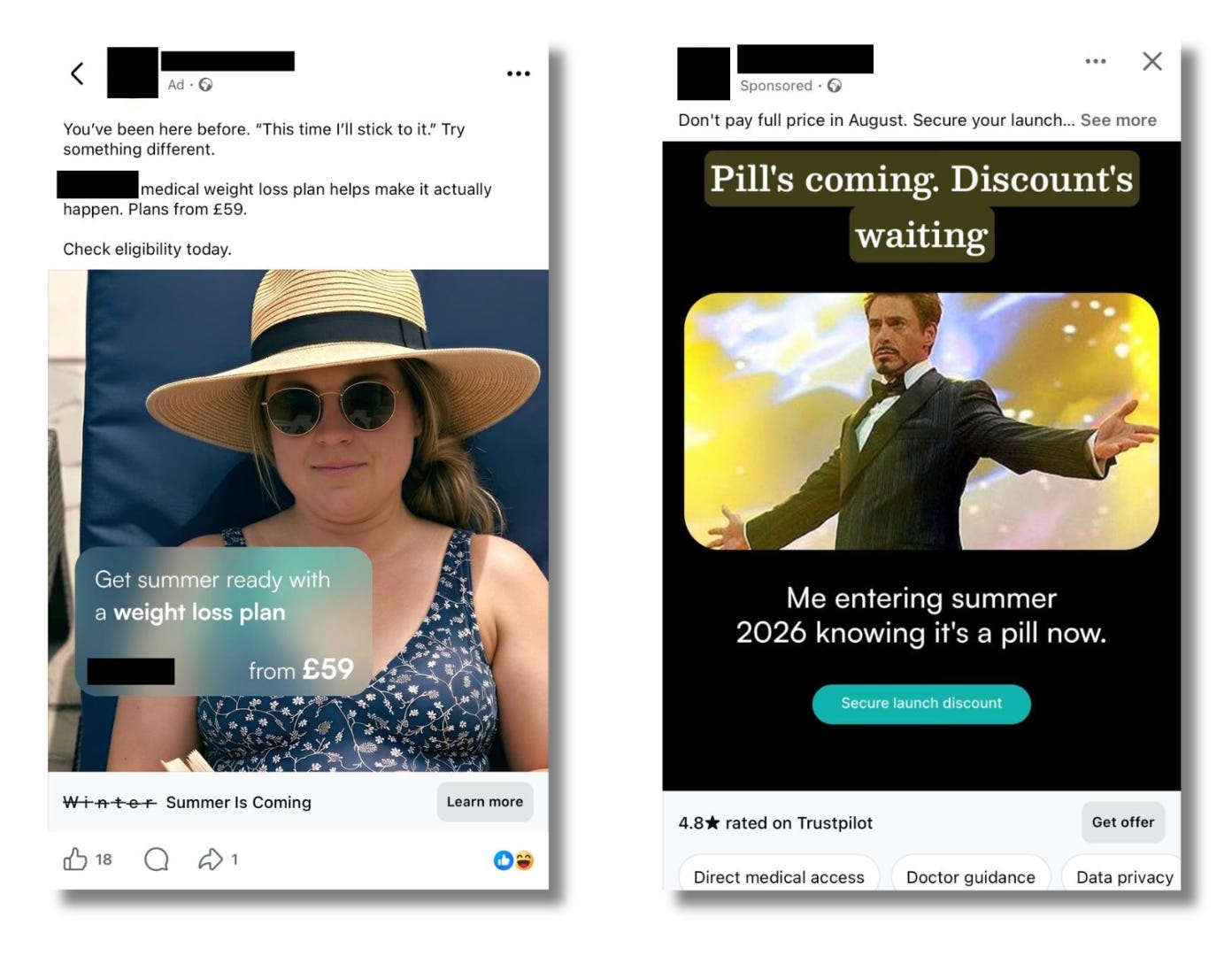
Deb mentioned that the origin of the productivity ad could have even been the government. There’s interest in Whitehall in GLP-1s and productivity, she said, but, again, the evidence isn’t yet there. In 2024 Lilly committed £279m alongside a real-world study run with Health Innovation Manchester. Five years, three thousand participants and designed to measure employment status and days off sick.
Regardless of the results, the state is spending five years and £279m trying to find out the truth. There’s currently no empirical evidence that these drugs improve non-clinical economic outcomes, yet this advertiser sold employers a clear benefit. And that’s without even entering any morality debate.
It gets worse…
